
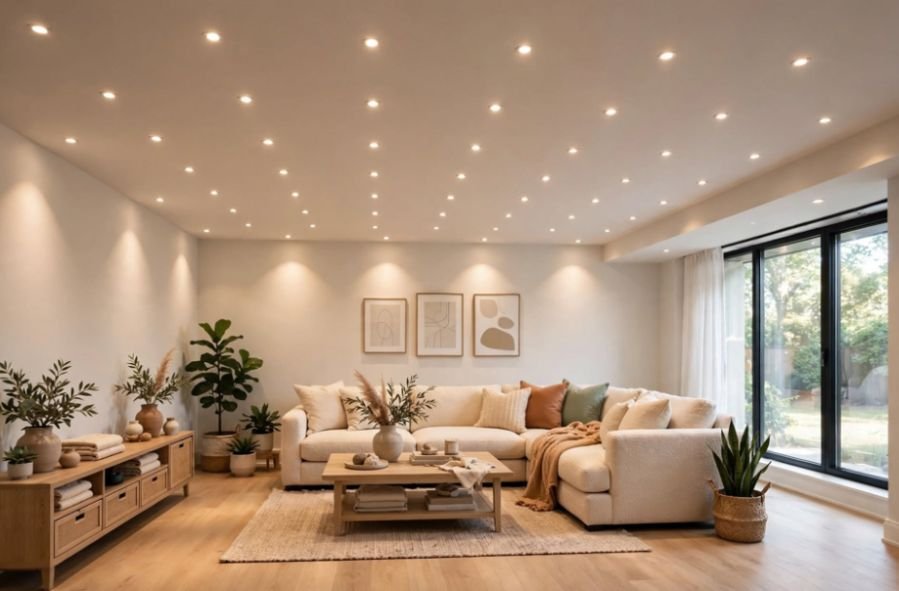
I finished my basement and immediately regretted my first lighting plan. Six bulky cans, four feet off the walls, left a dark ring around the entire room and made my 7-foot-2 ceiling feel like a cave.
The best indoor lighting placement for low ceiling basements is not about more lights. It is about flatter lights, tighter spacing, and bouncing light off the right surfaces.
I Learned The Hard Way That Low Ceilings Change Everything
Light spreads in a cone. When you lower the ceiling, you cut that cone in half. The floor gets bright spots and dark gaps. I had to redo the whole grid. After testing, I found that overlapping those cones is the only way to kill the cave effect without dropping the ceiling even lower.
The Primary Grid That Actually Fixes Dark Corners
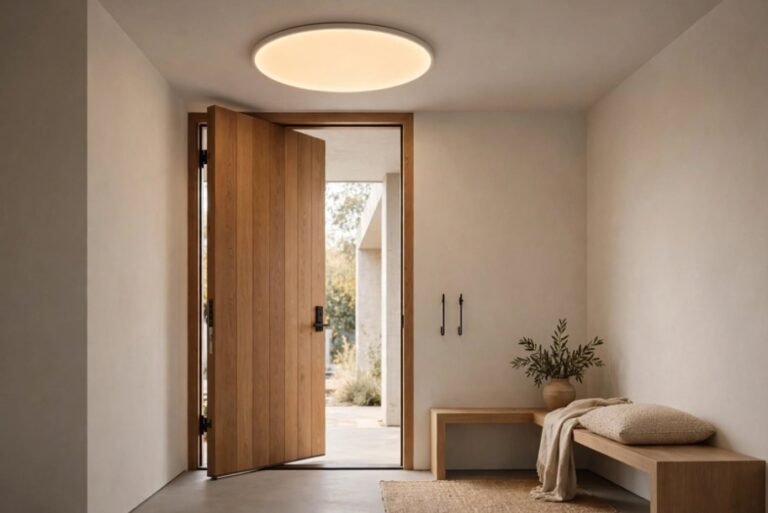
Your main ambient light has to sit flush. No pendants in walkways. No big drums.
How Far Apart and How Far From The Wall
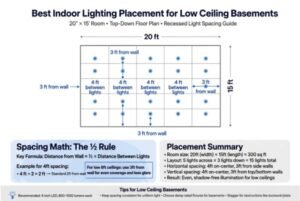
For any ceiling under 8 feet, I use the half-height rule. Divide your ceiling height by two. That number is your max spacing. An 8-foot ceiling means 4 feet apart. My 7-foot-2 ceiling needed 3.5 feet.
I keep the outer row exactly 2 to 3 feet from the wall. Too close creates harsh scallops down the drywall. Too far leaves the perimeter dark. The clean formula I now use is: Wall length divided by number of lights equals spacing between lights.
Half of that spacing is your distance from wall to first light. For more detailed lighting design recommendations, the Illuminating Engineering Society provides professional standards and guidance for effective illumination planning.
Why I Switched To Canless Ultra-Thin LEDs
Old can lights need 4 to 5 inches of joist space. Canless LED pucks are about 0.5 inches thick. They clip straight into drywall and slide right under joists and ductwork. I did not have to move a single joist. They also save energy.
The ENERGY STAR guide to recessed downlights shows why these low-profile LEDs run cooler and use a fraction of the wattage.
If your basement is completely unfinished, you can also light a living room with no overhead lighting using floor and wall layers, but for basements you want that flush overhead base first.
The Height Trick That Makes 7 Feet Feel Like 8
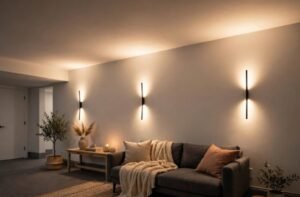
Ambient light alone flattens a low basement. You need vertical light.
Wall Sconces That Bounce Light Up
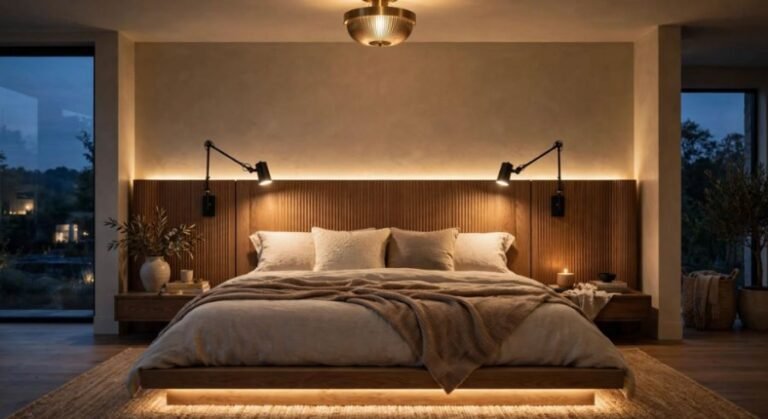
I installed slender sconces 5.5 feet high, spaced 8 to 10 feet apart on my longest wall. I chose fixtures that throw light both up and down and protrude less than 6 inches.
That up-light washes your white ceiling and tricks the eye. The room instantly felt taller.
nterior designers often use layered lighting techniques, such as uplighting and indirect illumination, to create a greater sense of height and openness in smaller spaces, as highlighted in Architectural Digest’s lighting design ideas.
Perimeter Cove Lighting For Depth
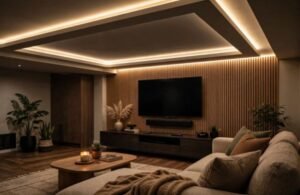
I added a simple 3-inch trim ledge around the media wall and hid a 2700K LED strip inside it. That soft line around the edge adds depth. It works behind a media console or inside a tray ceiling. It costs under $40 and makes the border of the room glow instead of disappearing.
Where You Can Break The Low Ceiling Rule
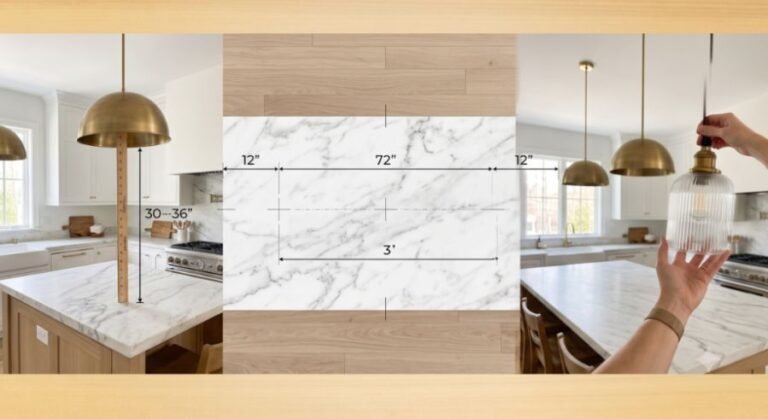
You can hang something lower only over places where no one walks. I have a compact semi-flush over my coffee table and two mini pendants over the wet bar.
I keep the bottom at 6 feet 9 inches minimum above the floor. That is code-friendly and headroom-safe. Everywhere else stays flush.
My Exact Placement Math For A 20×15 Basement
Here is what I did in my main lounge zone. The room is 20 feet long by 15 feet wide with a 7.5-foot ceiling.
I wanted two rows of four lights. For the 20-foot direction: 20 divided by 4 equals 5 feet between lights.
Half of that is 2.5 feet from the wall to the first light. For the 15-foot direction: 15 divided by 2 equals 7.5 feet between rows.
Half is 3.75 feet from the wall. I tightened it to 3.5 feet spacing between all fixtures to get more overlap.
Result: 8 lights, zero dark corners, no joist cutting. I used 4-inch, 2700K, 90 CRI canless LEDs on two dimmer zones.
If you connect some of these fixtures to smart bulbs for voice control, troubleshooting a smart bulb not responding to Alexa can help you quickly restore control without changing the physical lighting layout.
This tighter grid is exactly what This Old House recommends for low basement ceilings when headroom is limited.
Pro Finishes That Make Or Break The Glow
Three details changed everything after placement. I zoned the controls. TV wall on one dimmer, play area on another. I never light the whole basement at once now.
I stuck to 2700K to 3000K warm white. I also paid attention to color rendering, since a higher-quality LED can make basement finishes and furnishings look more natural; this is where knowing what CRI is good for home lighting becomes useful when choosing your bulbs.
Cool white made the concrete walls feel clinical. I painted the ceiling in flat bright white with 80+ Light Reflectance Value. It bounced twice as much light as my old light gray.
Frequently Asked Questions
1. What spacing for recessed lights in a 7 foot basement?
Keep them 3 to 3.5 feet apart with the outer row 2 to 2.5 feet from walls for full overlap.
2. What lights are best for low ceilings without dropping headroom?
Ultra-thin canless LED recessed lights at 0.5-inch depth and low-profile flush mounts.
3. How high should wall sconces go in a basement?
Mount at 60 to 66 inches from floor so up-light hits ceiling and down-light defines the wall.
4. Can you use pendant lights in a low ceiling basement?
Only over stationary furniture like a pool table or bar with at least 81 inches clearance from floor to fixture bottom.
Final Flicker: Stop Fighting Your Ceiling And Light It Smarter
Low does not have to mean dark or cramped. Push your main grid flush, tighten the spacing, and let your walls do the lifting. I did, and my basement finally feels like a living room instead of a bunker.
Try the wall-divided-by-lights math on your longest wall tonight and you will see the grid before you buy a single fixture.


5 thoughts on “Best Indoor Lighting Placement For Low Ceiling Basements”