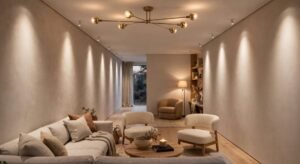
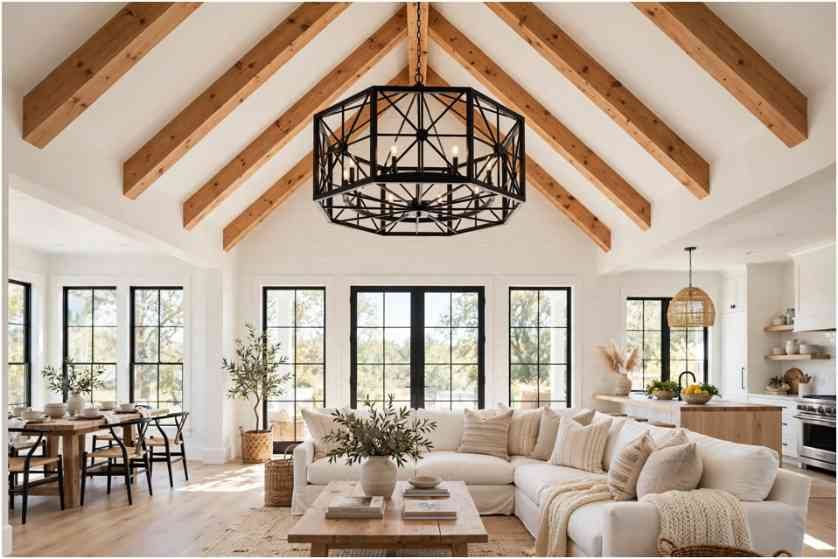
I made every mistake possible in my first open-concept with a 19-foot vault. During the day it was stunning. At 7pm it was a black hole.
The recessed lights I installed lit the floor but left the peak in shadow, and the whole living-kitchen-dining area felt like one giant, undefined warehouse.
Vaulted ceiling indoor lighting ideas for open concept spaces only work when you stop thinking about fixtures and start thinking about zones.
When you have no walls, light becomes your walls. Here is the exact layering system I now use.
Why Your Beautiful Vaulted Ceiling Goes Dark at Night
Standard flat-ceiling logic fails here. Light from a high peak has to travel too far to be useful. If you rely on just one central fixture, you get glare at the top and darkness at the bottom. If you rely only on recessed cans, you lose the architecture.
I learned to split my plan into three heights: high peak lighting to show off volume, mid-slope lighting for even ambient coverage, and eye-level lighting for human comfort. I also map my indoor lighting placement by activity, not by square footage.
1. I Anchor Each Zone With One Big Statement Fixture
In an open concept, you need visual anchors or the eye wanders. I use one oversized fixture per 150 sq ft zone. That one decision separates living from cooking.
Living Zone: Bring The Peak Down To Human Scale
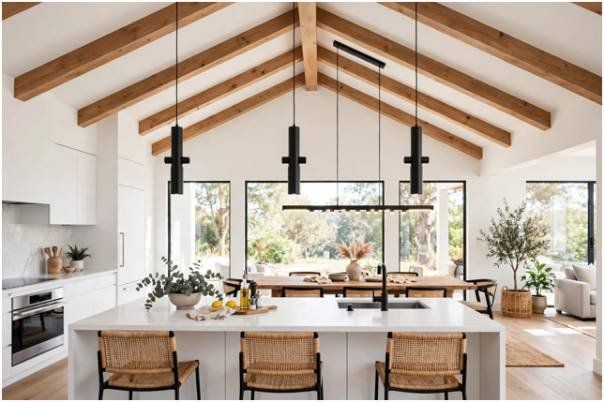
I hang a large chandelier dead-center in the vault peak. Not a small builder-grade drum. Think 36 to 48-inch wagon wheel, geometric cage, or double ring. It fills the negative vertical space and brings scale down.
I keep it on a dimmer at 2700K so it glows, not glares. The scale rule from Architectural Digest helped me here – chandelier diameter should be about one-half to two-thirds the width of the sofa or sectional below it.
Kitchen & Dining: The Linear Separation Trick
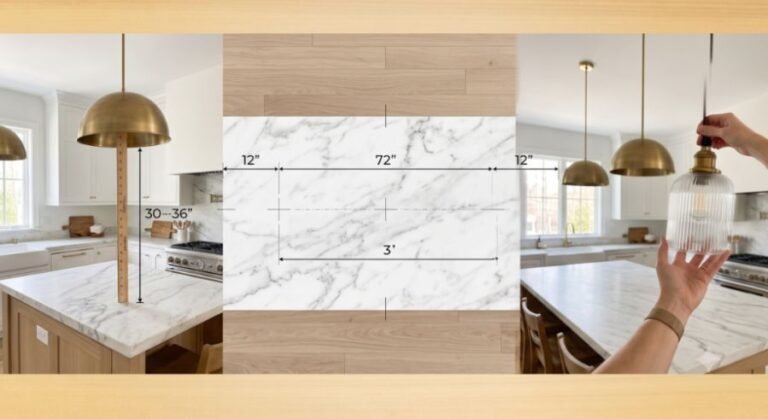
Over the island, I drop 2-3 matching pendants at 32 inches above the countertop. Over the dining table, I switch to a single linear chandelier. The change in shape tells your brain this is a different room, even without a wall. This low-hanging task light is non-negotiable for prep safety.
2. I Use The Architecture Itself As A Light Source
If your ceiling has beams, trusses, or a drywall ledge, light it. This is where you get that soft magazine glow.
Exposed Beams and Trusses
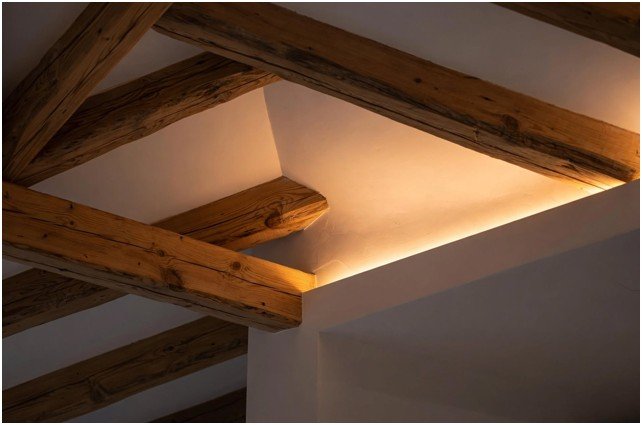
I never put a downlight on the bottom of a beam. It creates harsh stripes. I mount small black gimbal spots on the side of the beam, angled to wash light across the ceiling face. It highlights wood grain and pushes reflected light back into the room.
Hidden Cove LEDs – My Favorite Fix
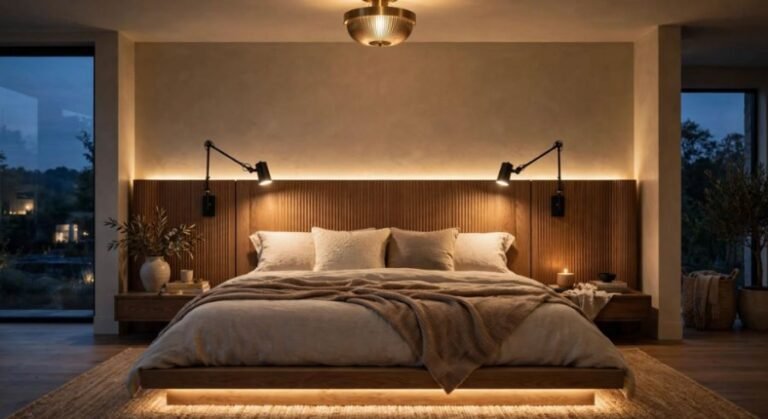
This is the single best trick I found. I install hidden LED tape on top of perimeter ledges, mantel beams, or the top plate of a wall. Point it upward. The light bounces off the slope and eliminates the dark shadow in the peak. It adds zero visual clutter.
For installation ideas, HGTV’s cove lighting guide shows how pros hide the tape channel. I run mine on a separate dimmer and leave it at 20% all evening.
3. The Foundation: Sloped Recessed Lighting That Actually Works
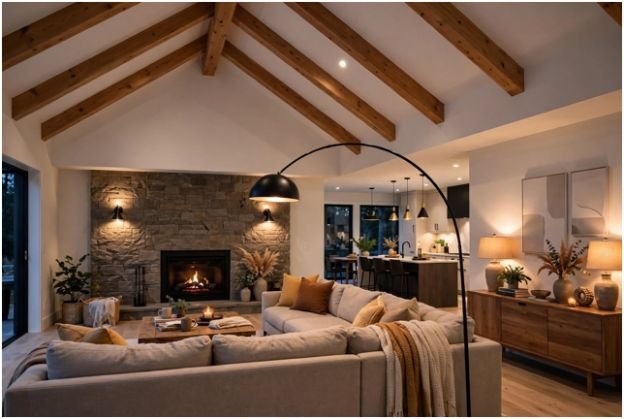
You still need a clean ambient grid. But a standard flat housing on a 30-degree slope shoots light at the wall.
I only use sloped-ceiling housings with adjustable gimbal trim. The housing keeps the bulb vertical, and the gimbal lets me tilt the beam straight down or angle it to highlight art. The Spruce breaks down why IC-rated, sloped housings matter for energy and safety.
I space mine 4-5 feet apart along the lower third of the vault slope, not clustered in the flat center. This evens out footcandles. When I measured with a light meter, this dropped my dark spots from 15 footcandles to a consistent 35-40.
For anyone also trying to brighten a dark hallway with no natural light connected to your open concept, the same gimbal strategy prevents that tunnel feeling.
I also switched all my cans to ENERGY STAR certified LEDs per Department of Energy guidelines. They run cooler in insulated vaults and save me about $75 a year in that one room.
4. Pull Light Down To Eye Level Or It Will Never Feel Cozy
Overhead-only design is why open concepts feel sterile. You need pools of light at 4 to 6 feet high.
I flank my floor-to-ceiling stone fireplace with vertical sconces. It breaks up heavy stone and adds human-scale height. Then I add large arc floor lamps over sectional corners and heavy ceramic table lamps on sideboards. Those warm pools are where people actually talk and read. Without them, you are lighting a lobby, not a living room.
My Final Formula That Stops The Cavern Effect
Here is the original test I run now on every project. In my 900 sq ft open living-dining-kitchen, I use: 1 oversized living chandelier (400W equivalent dimmed to 40%), 3 island pendants, 1 linear dining fixture, 8 sloped gimbal recessed lights, 12 feet of hidden cove LED, and 5 eye-level lamps/sconces.
Each layer on its own dimmer. Daytime scene is recessed + cove at 100%. Evening scene is cove at 20%, chandeliers at 50%, lamps at 100%. It took three attempts to get right, but it finally stopped feeling like a cavern or a warehouse.
FAQs
1. What is the best type of recessed light for a vaulted ceiling?
Sloped-ceiling housing with gimbal trim so you can aim the beam straight down.
2. How low should pendants hang over a kitchen island with high ceilings?
30 to 36 inches above the countertop, regardless of ceiling height, to define the zone.
3. How do you light an open concept living room with no overhead wiring?
Use cove LEDs, arc floor lamps, and wall sconces fed from existing outlets to create zones without ceiling work.
4. Should vaulted ceiling lights be warm or cool?
Warm 2700K-3000K dimmable for living zones, it makes tall wood and drywall feel cozy at night.
Stop Lighting Your Vault Like a Warehouse
Your vaulted ceiling was built to be seen, not to disappear after sunset. Stop trying to light it with one fixture. Zone it with a big anchor, wash the architecture with hidden LEDs, build a proper sloped recessed grid, then drag warm light back down to eye level. Start with dimmers on everything. That is the fix.