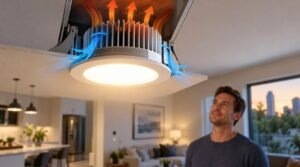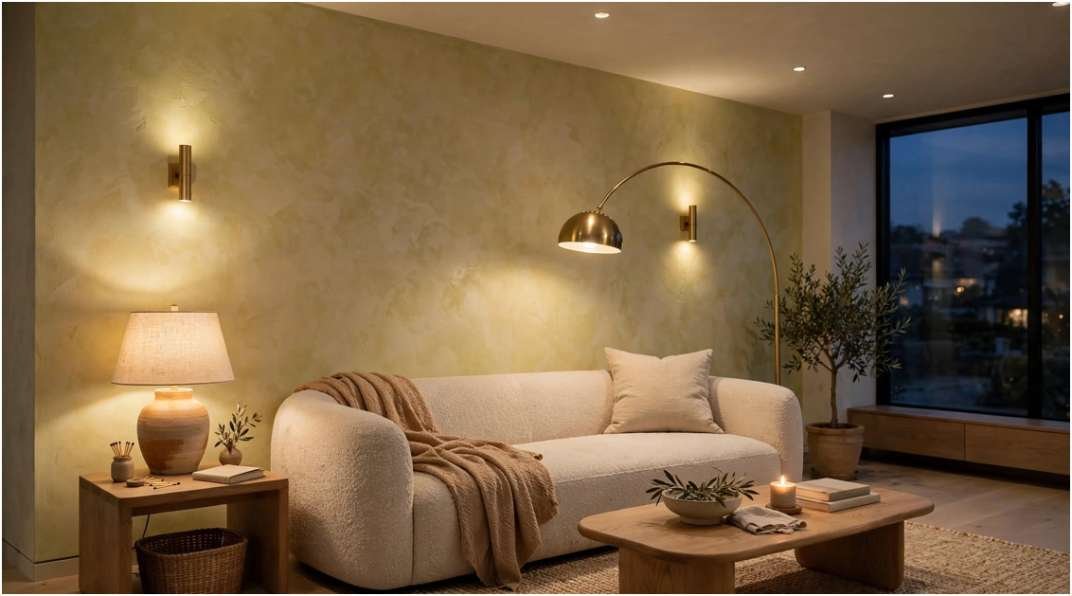
A standard living room needs 10 to 20 lumens per square foot for general ambient lighting. For an average space measuring between 150 and 250 square feet, you need 2,000 to 5,000 total lumens distributed across multiple fixtures.
If you attempt to blast those 3,000 lumens out of a single ceiling fixture, your room will feel like an interrogation box. When clients ask me how many lumens do I need to light a living room, my answer always hinges on two variables: your room’s physical dimensions and how you layer those light sources across different heights.
The Baseline Formula for Living Room Lumens
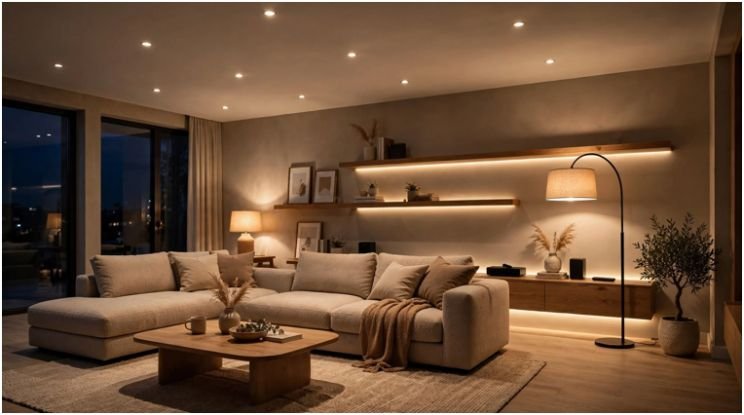
Lighting design does not rely on guesswork. It starts with simple geometry and guidelines established by the Illuminating Engineering Society (IES).
$$\text{Total Lumens Needed} = \text{Square Footage} \times \text{Target Foot-Candles}$$
One foot-candle equals one lumen per square foot.
Step 1: Calculate Your Floor Square Footage
Measure the length and width of your room in feet and multiply the two numbers:
$$\text{Length} \times \text{Width} = \text{Total Square Feet}$$
A 14-foot by 18-foot living room equals 252 square feet.
Step 2: Apply the Foot-Candle Rule
Different tasks require different illumination levels:
| Lighting Function | Lumens per Sq. Ft. | Primary Living Room Activity |
| Ambient (Base Level) | 10 – 20 | Conversation, lounging, watching TV |
| Task (Focused Work) | 30 – 50 | Reading in an armchair, board games, crafting |
| Accent (Display) | Variable (2–3x ambient) | Highlighting architectural niches, art, bookshelves |
For general ambient living, multiply your 252 sq. ft. room by 15 lumens:
$$252 \times 15 = 3,780\text{ ambient lumens}$$
According to Energy Star guidelines, a standard 60-watt equivalent LED bulb delivers approximately 800 lumens. That 3,780-lumen baseline equals roughly five standard LED bulbs spread through the room.
Real-World Adjustments Most Calculators Miss
The baseline formula assumes an empty box with white walls and standard 8-foot ceilings. Real homes differ. When I audit a living space, two physical factors change the lumen baseline immediately.
Wall Paint and the Light Reflectance Value (LRV)
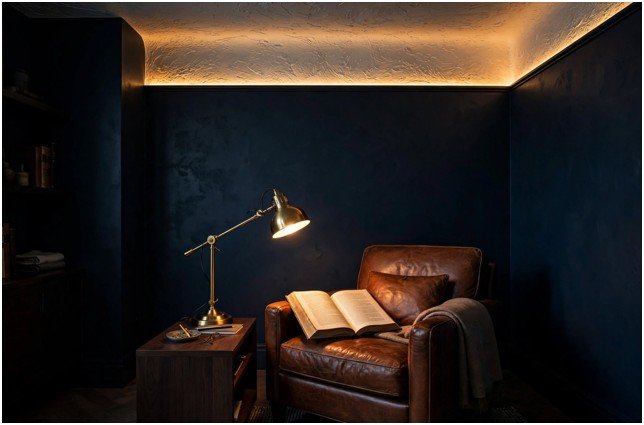
Paint chips display an LRV number from 0 to 100. A pure off-white paint reflects up to 80% of light. A deep navy, slate gray, or dark green reflects less than 15%, absorbing the rest.
If your walls have an LRV below 50, increase your base lumen calculation by 20% to 30%. Without that bump, a dark-painted room will feel dingy even when the math says you have enough light.
Ceiling Height and Distance Decay
Light follows the inverse-square law: luminous intensity decreases rapidly as the distance between the fixture and the floor expands.
- 8-foot ceilings: Use standard baseline numbers. For tight spaces, explore strategic indoor lighting placement for low ceiling layouts to keep direct glare out of seated sightlines.
- 10-foot ceilings: Add 10% to your total lumen output.
- 12-foot or vaulted ceilings: Add 20% to 25% to your ambient fixture capacity.
The 50-30-20 Layering Rule Across Fixtures
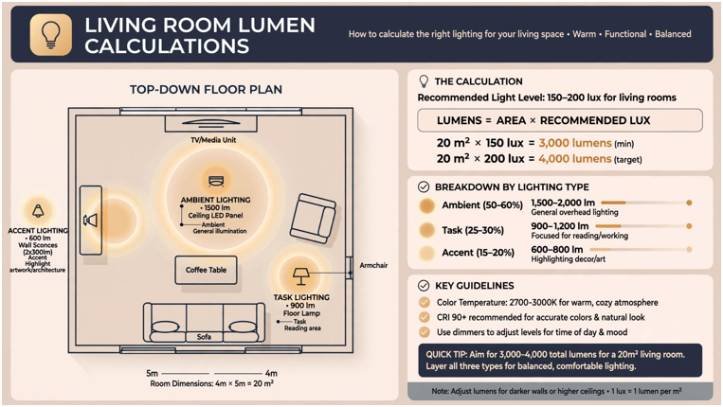
The biggest mistake homeowners make is installing high-output cans or an overly bright central chandelier to hit their target in one shot. High single-point lumens create harsh shadows under noses, deep eye socket shadows, and unflattering glare across television screens.
Distribute your calculated output across three distinct layers.
Total Lumens (100%)
├── Overhead / Recessed (50%) -> General perimeter and wash
├── Floor & Table Lamps (30%) -> Seated eye-level task light
└── Accent / Sconces (20%) -> Perimeter depth and vertical interest
Overhead and Recessed (50% Ambient)
Dedicate roughly half your total lumens to overhead fixtures. For a 3,600-lumen target, your ceiling circuit should handle roughly 1,800 lumens. Use diffused fixtures or wide-beam recessed cans fitted with warm 2700K bulbs. Always pair this layer with an LED-compatible dimmer.
If your home lacks hardwired ceiling boxes, you do not need to tear into the drywall. You can light a living room with no overhead lighting by bouncing floor-directed uplights off the ceiling plane to create soft, reflected ambient illumination.
Floor and Table Lamps (30% Task)
Place 30% of your output (around 1,000 to 1,200 lumens in our example) at seated eye level. An adjustable reading lamp alongside a sectional should emit 450 to 800 lumens on its own. Table lamps flanking the sofa fill in the mid-room shadows that overhead lighting misses.
Accent and Architectural (20% Perimeter)
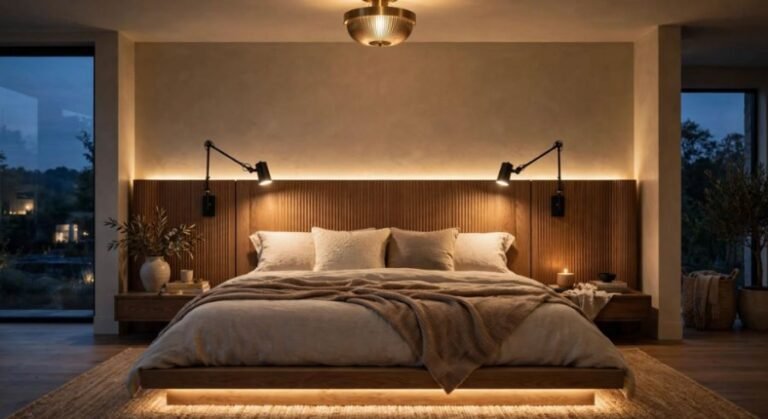
Allocate the remaining 20% (about 600 to 800 lumens) to vertical surfaces. Wall sconces, LED bias backlighting behind the media console, or low-voltage cabinet pucks draw the eye outward. Illuminating the walls makes the boundaries of the room expand visually at night.
Worked Living Room Layout Examples
Here is how common floor plans translate into actual hardware and bulb selections based on the U.S. Department of Energy (DOE) lighting metrics:
| Room Size | Dimensions | Ambient Lumen Target | Recommended Fixture Distribution |
| Small | 10′ x 12′ (120 sq. ft.) | 1,500 – 2,000 lm | • 1 Semi-flush ceiling light (800 lm)
• 2 Table lamps (450 lm each) |
| Medium | 14′ x 16′ (224 sq. ft.) | 2,500 – 3,500 lm | • 4 Recessed cans (450 lm each)
• 1 Arc floor lamp (800 lm) • 2 Table lamps (450 lm each) |
| Large | 16′ x 22′ (352 sq. ft.) | 4,000 – 5,500 lm | • 6 Recessed cans (500 lm each)
• 2 Reading floor lamps (800 lm each) • 2 Wall sconces (400 lm each) |
Always keep color temperature uniform within each sightline. Mixing a 2700K warm table lamp with a 4000K daylight overhead can makes warm wood tones look mismatched and causes visual fatigue.
Frequently Asked Questions
1. Are 3,000 lumens too bright for a living room?
No, 3,000 lumens is the ideal output for an average 150- to 200-square-foot living room when divided among three or four separate light fixtures.
2. Can I use a single 4,000-lumen fixture to illuminate my living space?
Avoid doing this, as a single high-output source creates intense glare and deep shadows across the perimeter of the room.
3. How many lumens do I need for reading in a living room?
A focused reading light should supply 400 to 800 lumens directly over your shoulder or reading surface.
4. What color temperature works best with these lumen levels?
Keep living rooms between 2700K and 3000K to maintain a relaxing atmosphere without a sterile, blue cast.
Stop Eyeballing Your Light Fixtures
Stop buying bulbs based on old wattage habits and hoping the room feels right after dark. Grab a tape measure, calculate your square footage, multiply it by 15, and allocate half that number overhead and the rest to lamps at eye level. Throw every primary light on a dimmer switch, and you will never sit in a dim or blinding living room again.