
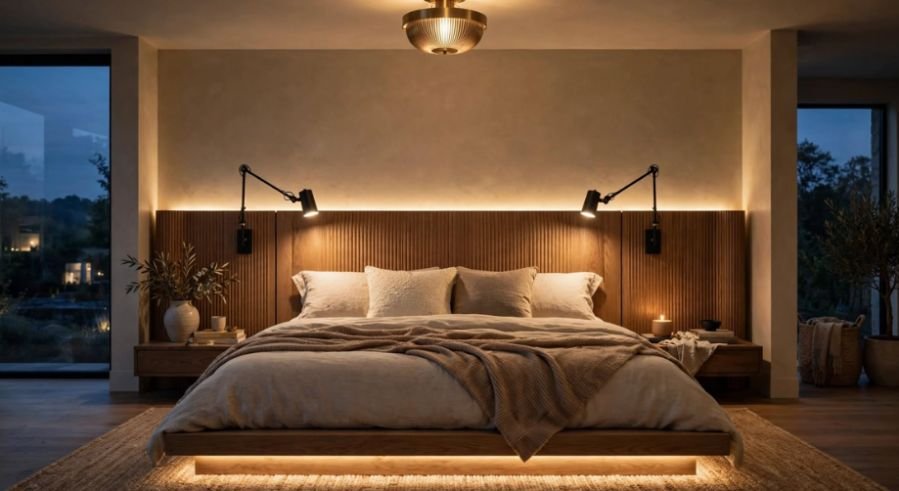
A single overhead ceiling fixture turns a bedroom into a sterile interrogation room. When I renovated my master suite, I learned the hard way that figuring out how to layer ambient task and accent lighting in bedroom floor plans is the difference between a restless space and a restorative sanctuary. You need balanced, cohesive illumination that shifts effortlessly from energetic mornings to restful evenings.
Achieving this balance requires understanding how three distinct light layers interact, how to size their brightness, and how to control them independently.
The Core Principle: The 5:3:1 Layering Rule
Most homeowners install light fixtures haphazardly without considering contrast ratios. In professional lighting design, we balance light across three distinct focal zones.
I use an adapted 5:3:1 luminous hierarchy for sleeping quarters:
- 5 Parts Ambient: Provides overall diffuse floor-to-ceiling volume.
- 3 Parts Task: Concentrates focused beams on functional work zones without washing out the room.
- 1 Part Accent: Adds subtle focal highlights to textured walls, artwork, or structural perimeters.
This ratio keeps task surfaces bright enough for reading while preventing accent lights from fighting the room’s base layer.
Layer 1: Ambient Lighting (The Foundation)
Ambient lighting establishes your baseline visibility. It replaces natural daylight on dark winter mornings and lets you navigate the space, make the bed, and put away clothes safely.
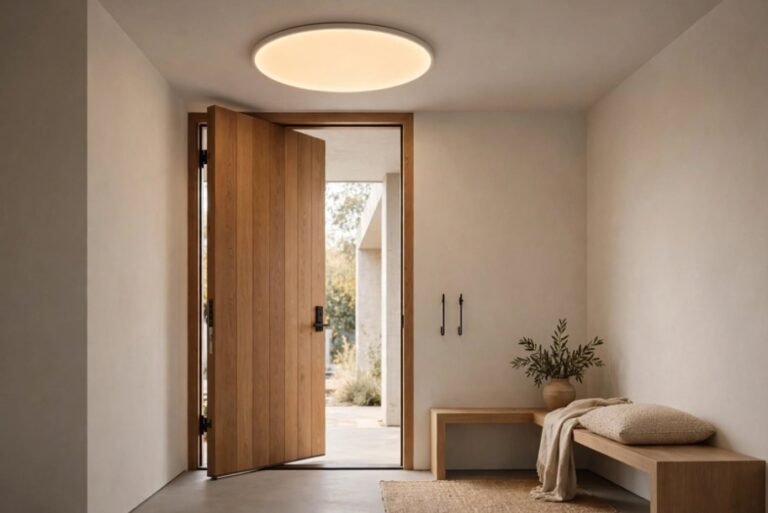
For primary ambient fixtures, flush-mounts, semi-flush drums, and low-profile chandeliers work best. If you have low overhead clearance, explore principles like indoor lighting placement for low ceiling basements to avoid fixtures that crowd your vertical line of sight.
The Illuminating Engineering Society (IES) recommends maintaining 10 to 20 footcandles of general illuminance for residential bedrooms.
Room Area (sq. ft.) × 15 Footcandles = Target Ambient Lumens
For a 12′ × 14′ bedroom (168 sq. ft.), aim for roughly 2,500 total lumens across your ambient circuit.
Sizing and Positioning Ambient Fixtures
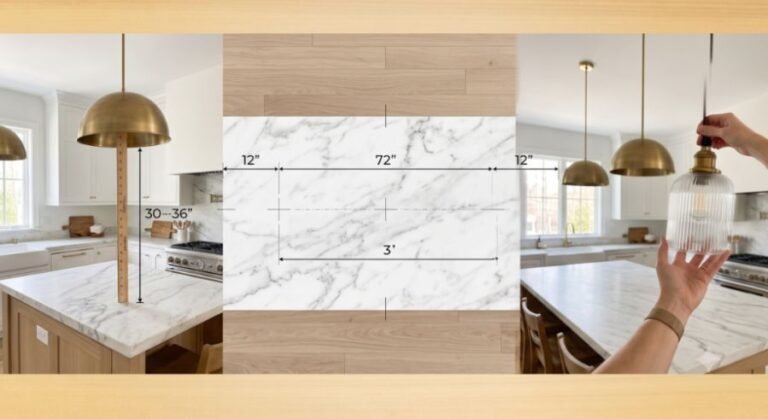
Never position a direct recessed downlight directly over the pillows. The same placement principle applies when planning other overhead fixtures; for example, a kitchen island pendant light spacing and height guide can help you understand how fixture height and spacing affect sightlines, glare, and usable task areas.
Staring up into a raw beam while lying flat creates immediate visual fatigue. Instead, align ambient fixtures over the lower third of the mattress or along open walking pathways.
Layer 2: Task Lighting (Targeted Performance)

Task lighting delivers high-intensity, localized beams to active areas: reading in bed, grooming at a vanity, or dressing in walk-in closets.
According to residential guidelines from ENERGY STAR, dedicated task stations require focused output without spilling glare into surrounding resting zones.
Bedside Reading and Vanity Placement Rules
Bedside sconces should feature articulated or swing arms. Mount them 30 to 36 inches above the mattress surface. This height places the bottom rim of the shade roughly level with your eyes when you sit propped against the headboard.
For vanities, skip top-mounted downlights. Overhead vanity lighting casts heavy shadows beneath your eyes and chin. Mount vertical linear fixtures or frosted sconces on either side of the mirror at eye level (60 to 65 inches from finished floor) to bathe your face in even, horizontal light.
Layer 3: Accent Lighting (Atmosphere and Depth)
Accent lighting builds drama and visual depth. It softens perimeter shadows and draws attention to architectural details, wallpaper, or framed art.
Research indexed by the National Institutes of Health (NIH) emphasizes that exposure to high blue-light frequencies late in the evening suppresses natural melatonin secretion. Accent layers provide low-lumen, warm-wavelength illumination that relaxes the nervous system prior to sleep.
Concealing Sources for High-End Visual Warmth
The golden rule of accent lighting: show the glow, hide the source.
Install low-voltage LED tape inside an extruded aluminum channel with an opal diffuser behind your headboard. You can also run toe-kick lighting under floating nightstands. The indirect bounce creates soft perimeter illumination that doubles as a glare-free pathway light for middle-of-the-night trips to the bathroom.
This same layered approach works well beyond the bedroom; if a room has no central ceiling fixture, you can light a living room with no overhead lighting by combining floor lamps, wall lighting, and indirect uplighting.
Master Bedroom Lighting Specification Matrix
Use this engineering cheat sheet to select fixtures, targets, and color temperatures across all three layers.
| Lighting Layer | Primary Purpose | Ideal Fixture Types | Recommended Output (Lumens) | Ideal Color Temp (Kelvin) | Minimum CRI |
| Ambient | Overall navigation & cleaning | Semi-flush drums, chandeliers, indirect coves | 2,000 – 3,500 lm (total) | 2,700K | 90+ |
| Task | Reading, styling, dressing | Articulated sconces, shaded table lamps, vanity bars | 450 – 800 lm (per source) | 2,700K – 3,000K | 95+ |
| Accent | Visual depth, texture & mood | Concealed LED channels, picture lights, toe-kick tape | 150 – 300 lm (per linear ft) | 2,200K – 2,400K | 90+ |
Switching Schemes and Smart Controls
Layering fails if everything turns on with a single wall switch. Split your lighting into at least two, preferably three, independently controlled circuits:
- Circuit A (Ambient): Primary ceiling fixtures wired to a main switch by the doorway.
- Circuit B (Accent): Headboard grazing and cove lighting wired to a low-voltage controller.
- Circuit C (Task): Bedside sconces wired directly to localized rocker switches within arm’s reach of the mattress.
Equip all ambient and accent circuits with 0–10V or digital phase dimmers. Being able to scale brightness down to 10% prepares your circadian cycle for sleep without plunging the room into darkness.
Frequently Asked Questions
1. Can I mix different color temperatures in the same bedroom?
Keep ambient and task layers within 2,700K to 3,000K, but you can drop accent lights to a warmer 2,200K for bedtime mood lighting.
2. How do I calculate total bedroom lumens?
Multiply your room’s total square footage by 15 to 20 footcandles to get your baseline ambient requirement.
3. What is the best reading light wattage for bedside tables?
Choose an LED bulb producing 450 to 600 lumens, which equals roughly 6 to 8 watts in modern LED fixtures.
4. Should bedroom recessed downlights be on a dimmer?
Yes; un-dimmed recessed lights produce harsh shadows and high glare that disrupt pre-sleep winding down.
Ditch the Glare: Your Bedroom Glow-Up Plan
A cozy bedroom needs more than one overhead switch. Start by walking into your room at dusk: audit where harsh shadows gather and note where you squint to read. Add one dedicated task sconce and run a concealed warm LED strip behind your headboard this weekend. Separating those controls will instantly turn your bedroom from an ordinary sleeping box into a boutique retreat.





4 thoughts on “How to Layer Ambient Task and Accent Lighting in Bedroom”