
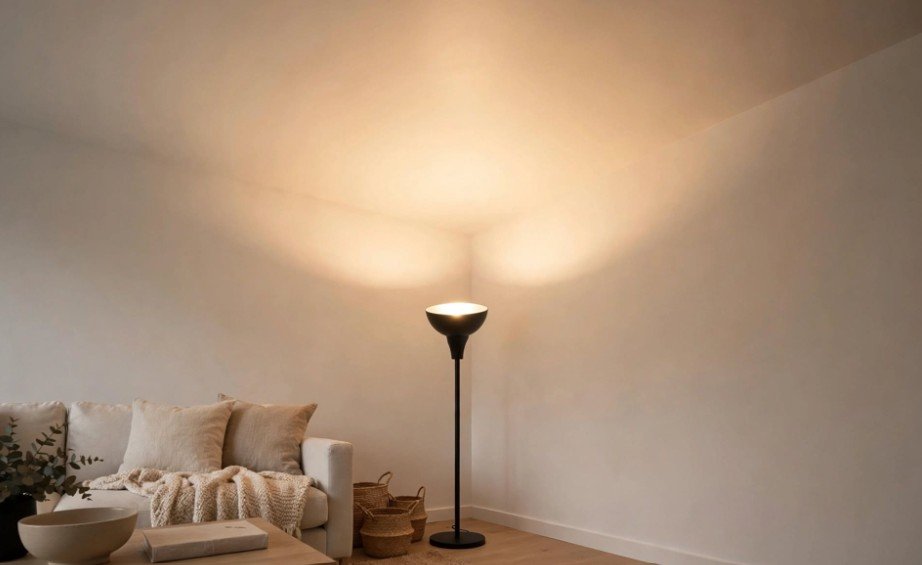
when I moved into my 1940s rental, the living room had exactly zero ceiling junction boxes. Walking into the space after sunset felt like stepping into an abandoned mineshaft. Learning how to light a living room with no overhead lighting taught me quickly that turning on three random table lamps just creates harsh pools of glare surrounded by gloom.
To make a fixtureless room feel bright, you cannot just add bulbs. You must bounce, angle, and layer light to replace the broad spread of a ceiling fixture.
+——————————————————————-+
| BOUNCE ZONE: Matte White Ceiling (80%+ Reflectance) |
| ^ ^ |
| / \ |
| [Torchiere Floor Lamp] [Arc Floor Lamp] |
| (3000K, 1600 lm) | |
| v |
| [Table Lamp] —- Eye-Level Glow (400-800 lm) -> [Seating Area] |
| |
| [Canister Uplight] -> Wall/Plant Shadow Fill |
+——————————————————————-+
The Physics of Ceilings: Why Rooms Feel Dim Without Hardwiring
Overhead fixtures do not just cast light downward; they blast light laterally across the upper third of your drywall. When that upper third stays dark, your brain registers the room as cramped and underlit, regardless of how bright your end-table reading lamps are.
Accounting for the Surface Reflectance Deficit
Standard matte white ceiling paint reflects roughly 80% to 90% of the light hitting it, according to technical data from Energy.gov. Darker accent walls drop that efficiency below 25%. When you have no central fixture, you face what I call the Surface Reflectance Deficit: your floor-based lamps lose up to 40% of their output before that illumination ever hits your eyes.
To overcome this deficit, calculate your room’s total baseline needs: multiply your square footage by 20 lumens. For my 250-square-foot living room, I needed 5,000 distributed lumens—not concentrated in one corner, but divided deliberately across three vertical planes.
Layer 1: Simulated Ambient Illumination
Ambient light provides the foundational base of brightness that makes a room functional. Without an overhead light, your vertical walls and ceiling must become that fixture.
/ \ <- High-output upward beam (1600+ lumens)
/ \
| |
|=====| Torchiere / Bowl Diffuser
|
|
| Heavy-gauge matte post
|
===== Weighted base to prevent tipping
Torchiere Uplights and the White-Ceiling Bounce
A quality torchiere is the single most effective weapon against a ceiling-less room. Unlike a traditional shaded floor lamp, a torchiere shoots light directly into the ceiling, turning the entire ceiling into an overhead reflector.
I use a heavy-gauge metal torchiere fitted with a 1,600-lumen LED bulb (the equivalent of an old 100-watt incandescent) rated at 2700K. Placing this fixture in the darkest corner pushes light across the ceiling plane, instantly eliminating that heavy, cave-like sensation overhead.
Arc Floor Lamps for Center-Room Presence
If your primary seating sits in the middle of the room away from the perimeter, a torchiere cannot carry the load alone. An arc floor lamp bridges that gap. The base tucks behind a couch while the arm curves out overhead, positioning a suspended drum shade directly over your coffee table.
Design editors at Architectural Digest routinely highlight arc lamps as structural anchors for open spaces. Choose a shade with an open top and a bottom diffuser. This allows downward task light for games or conversation while throwing a secondary halo upward.
Layer 2: Functional Task Zones Without Ceiling Junctions
Once the overhead plane is bright, focus on the middle layer: the seating and task surfaces sitting between 30 and 60 inches off the floor.
+————————————+————————————+
| Fixture Type | Core Function & Placement |
+————————————+————————————+
| Torchiere Uplight | High-volume ceiling bounce; corners|
| Arc Floor Lamp | Center-room overhead replacement |
| Plug-In Sconce | Wall-anchored reading illumination |
| Canister Floor Uplight | Depth creation behind large plants |
+————————————+————————————+
Flanking Sofa Arrangements with Targeted Eye-Level Light

End tables flanking your couch should hold matching table lamps with translucent fabric shades. Opaque metal shades point light exclusively downward, which creates high-contrast hot spots. Translucent linen or drum shades disperse soft, horizontal light right at seated eye level, making conversations comfortable and reading effortless.
Aim for 450 to 800 lumens per table lamp. Keep the bottom edge of the lampshade level with your eye line when you are seated on the sofa to prevent exposed-bulb glare.
Plug-In Wall Sconces with Cord Raceways
Renters often assume wall sconces require cutting drywall and running electrical boxes. Plug-in sconces bypass this entirely. Mounting two adjustable swing-arm sconces directly behind or beside your couch frees up valuable surface space on small side tables.
To keep the setup looking clean and intentional rather than messy:
- Secure the mounting plate with heavy-duty anchors.
- Run the loose cord through paintable metal cord raceways.
- Paint the raceway to match your wall color perfectly.
Layer 3: Perimeter Depth and Shadow Erasure
A room feels visually balanced when its perimeters have dimension.
The same principle applies outdoors, where how to install low-voltage landscape lighting properly can help create controlled perimeter illumination without overwhelming the surrounding space.
Dark, shadowy corners shrink rooms; subtle accent lighting visually expands them.
Canister Uplights Behind Large Foliage

One of my favorite interior tricks costs less than thirty dollars: an aluminum canister uplight tucked on the floor behind a large fiddle-leaf fig or monstera.
Pointing a narrow, 400-lumen spotlight up through the leaves casts soft, organic shadows up the wall onto the ceiling. This turns a dead room corner into a focal point while lifting shadows off the floorboards.
Low-Profile LED Runners and Bookcase Halos
Deep open bookcases frequently turn into dark voids at night. Adding self-adhesive LED tape strips along the inner front lip of each shelf bathes your books and decor in a warm glow.
Adding COB LED strip lights without a diffuser along the inner front lip of each shelf creates a continuous, warm glow that bathes your books and decor without requiring a bulky fixture.
Keep the color temperature aligned with the rest of your room—stick between 2700K and 3000K. Mixing cool 5000K strips with warm 2700K lamps makes a living space feel like an office lobby.
The Switch Problem: Syncing Scattered Fixtures Into One Circuit
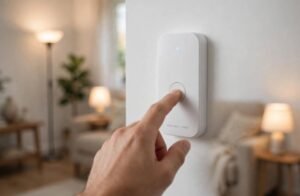
The most annoying part of living without overhead lights is walking around the room manually twisting six separate knob switches every time you enter or leave.
I resolved this by plugging every lamp into a coordinated smart plug ecosystem. Technical control standards from Lutron show that synchronized multi-device dimming stabilizes bulb life while cutting phantom energy draw.
[Wall Mount Smart Remote]
|
+—————-+—————-+
| (Wireless RF / Zigbee Trigger) |
v v
[Smart Plug A] [Smart Plug B]
(Torchiere: 100%) (Table Lamps: 50%)
Using a wireless smart switch mounted over the existing useless blank wall plate gives me real tactile control. One tap turns on the torchiere at full blast and brings the accent sconces up to 50% brightness. You get the convenience of a modern hardwired ceiling circuit without touching a single piece of wiring inside the wall.
Ditching the Boob Light for Good
A missing ceiling fixture often feels like an architectural flaw, but it is secretly an interior design advantage. Central flush-mount fixtures—often called “boob lights”—cast flat, sterile shadows that wash out textures and flatten room dimensions.
By distributing your light across vertical walls, upward ceiling bounces, and eye-level lamps, you build a space that feels intentional, layered, and significantly cozier than any single ceiling bulb could ever achieve.
Grab a tape measure, count your outlets, and establish your three layers. Your living room will feel bigger, warmer, and completely transformed before the weekend is out.
Frequently Asked Questions
1. What is the best way to light a room with no overhead lights?
Layer a high-lumen torchiere floor lamp to bounce light off the ceiling alongside eye-level table lamps and perimeter accent lights.
2. How do you brighten a dark living room without an electrician?
Use plug-in wall sconces with painted cord covers paired with smart plugs to operate multiple lamps from a single switch.
3. How many lamps do I need in a living room without ceiling lights?
Most medium-sized living rooms need three to five distinct light sources to balance ambient, task, and accent needs without casting shadows.
4. What bulbs work best for bounce lighting off ceilings?
Choose LED bulbs delivering 1,600 or more lumens with a warm white color temperature between 2700K and 3000K.






One thought on “How to Light a Living Room With No Overhead Lighting”