
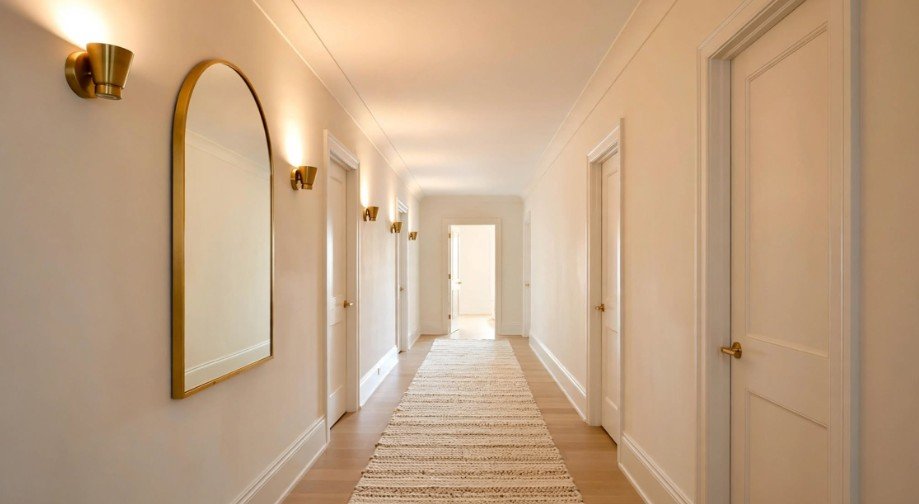
Windowless interior corridors feel like murky tunnels because they lack both natural ambient light and vertical bounce. When I renovated my first windowless ranch-style corridor, I made the classic rookie mistake: I screwed a blinding 5000K “Daylight” bulb into a lone ceiling fixture and painted the walls pure brilliant white. The space felt less like a designer home and more like an interrogation cell.
Learning how to brighten a dark hallway with no natural light requires a calculated balance of surface physics, bulb color temperatures, and strategic reflections. By correcting surface reflectance and redirecting light pathways, you can turn an enclosed pass-through into an inviting transition zone.
Rethinking Lumens, Kelvin, and Vertical Illumination
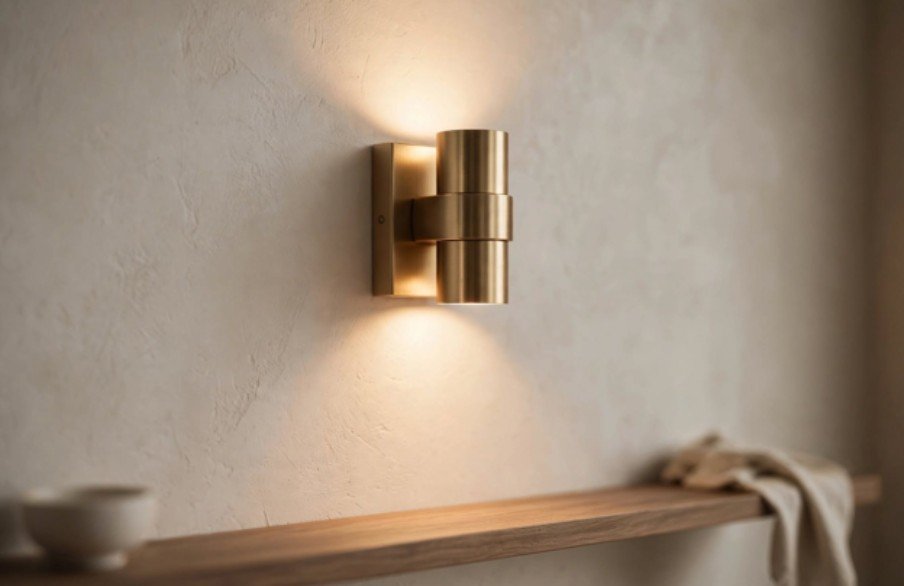
Overhead lighting alone causes deep shadows along baseboards, creating a claustrophobic optical illusion known as the “cave effect.” To conquer this, you must treat your corridor like a multi-point studio set.
[ Ceiling Plane ] <— Uplight Bounces Down
▲
│
[ Sconce ] ┤ (3000K Neutral)
│
▼
══════════════════════════════════════ [ Floor Plane ]
The 3000K Rule and Why Daylight Bulbs Backfire
Many homeowners assume windowless rooms need 5000K daylight bulbs to replicate the sun. In an enclosed corridor lacking real sunlight, 5000K LEDs cast a sterile, blue-gray cast that drains warmth from skin tones and decor.
Stick to 3000K to 3500K. This spectrum delivers crisp, clean white illumination without the muddy amber tint of 2700K or the surgical glare of 5000K. Pair this temperature with bulbs rated at 90+ on the Color Rendering Index (CRI), ensuring wood tones and artwork appear vivid. When dealing with similar challenges elsewhere, check our guide on how to light a living room with no overhead lighting.
Layering Uplights to Eliminate Tunnel Vision
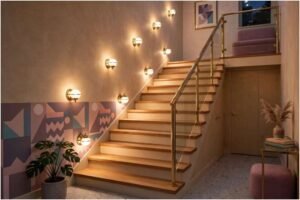
A dark hallway requires vertical wall washing.
The same layered approach can transform other rooms that lack effective overhead illumination. For bedrooms, look for our guide on how to layer ambient task and accent lighting in bedroom spaces to combine general illumination with focused and decorative light.
When you illuminate vertical wall planes rather than simply spraying light straight onto the floor, the walls appear pushed outward to the human eye.
According to guidelines from the Illuminating Engineering Society (IES), interior corridors require roughly 10 to 15 foot-candles of illuminance at floor level. Installing directional wall sconces that cast light upward against a light-toned ceiling doubles the perceived volume of the corridor.
If existing sconces, switches, or other fixtures behave unexpectedly after installation, check for common lighting wiring problems before replacing the fixtures themselves.
If your corridor features low headroom, apply the same principles used for indoor lighting placement for low ceiling basements, swapping hanging pendants for flush-mounted architectural diffusers.
The Science of Reflectance: Paint Finishes and LRV
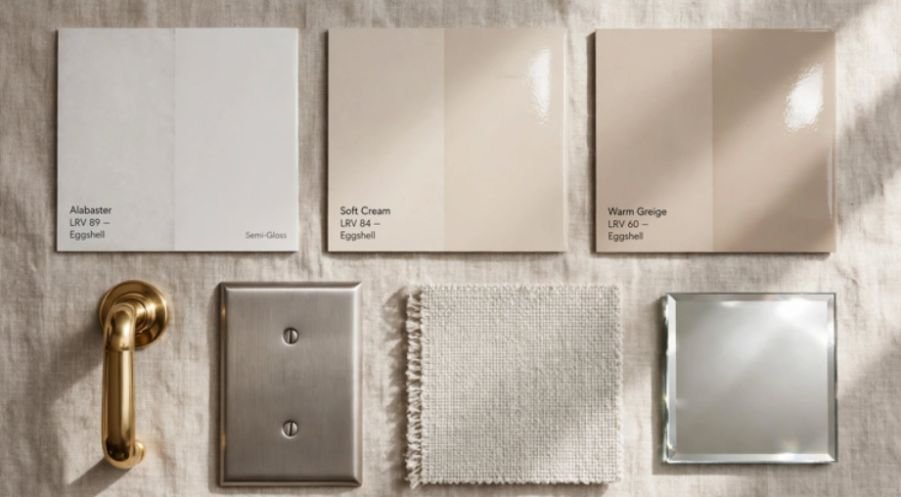
Paint manufacturers print an LRV (Light Reflectance Value) number on every swatch, running on a scale from 0 (absolute black) to 100 (pure white). In spaces devoid of windows, standard rules go out the window.
| Finish | Light Bounce | Cleanability | Best Used On |
| Flat / Matte | Absorbs light | Low | Uneven ceilings only |
| Eggshell | Soft dispersion | Moderate | Corridor walls |
| Satin | Crisp reflection | High | High-traffic walls |
| Semi-Gloss | Mirror-like sheen | Maximum | Doors, trim, moldings |
Selecting High-LRV Formulations
Never buy a paint color with an LRV below 70 for an enclosed hallway. Technical resources from Sherwin-Williams demonstrate that paints above 75 LRV amplify ambient foot-candles exponentially across narrow corridors.
Paint the ceiling, crown molding, baseboards, and interior doors the exact same color—such as a warm off-white. This monochromatic trick erases hard visual boundaries, preventing the eye from registering where the walls stop and the ceiling begins.
Strategic Mirror Placement and Visual Sightlines
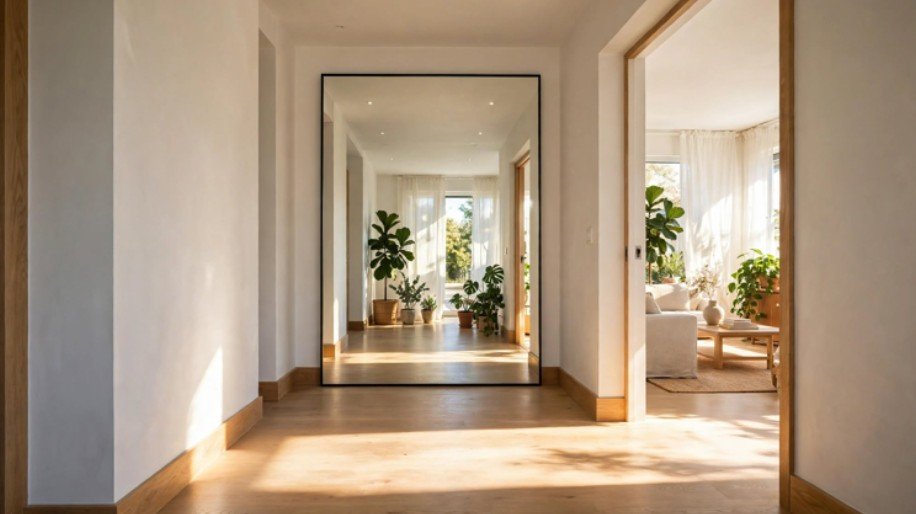
Mirrors do not manufacture light; they redirect it. If you hang a mirror opposite a blank wall in a dim hall, you simply double the visibility of that dark wall.
Instead, position an oversized mirror directly opposite a doorway that opens into a bright, sun-drenched room. This catches natural sunlight escaping from adjacent bedrooms or living spaces and bounces it straight down the corridor.
Opt for narrow console tables with glass or polished metal tops below the mirror. The metallic finishes double the output of nearby lamps, bouncing light into shadowed corners.
Flooring and Architectural Light Transference
Dark hardwood or slate flooring absorbs up to 85% of available foot-candles. If replacing the flooring is outside your budget, install a pale, low-pile runner rug down the center of the hall. Look for cream, oatmeal, or light greige tones with subtle lengthwise lines to elongate the visual plane.
For a permanent structural upgrade, swap solid wooden doors for frosted glass or French doors on connecting rooms. Installing glass transoms above doorways lets secondary sunlight flood the corridor while preserving acoustic privacy.
Quick Reference: Hallway Brightening Cheat Sheet
| Design Element | Common Mistake | Recommended Fix |
| Bulb Color | 2700K (too yellow) or 5000K (too blue) | 3000K–3500K neutral white (90+ CRI) |
| Wall Paint | Flat finish, dark or muddy undertones | Eggshell or Satin finish, LRV 70+ |
| Mirrors | Facing a blank, dark drywall section | Facing an open, sunlit doorway |
| Fixtures | Single flush mount in the middle | Recessed cans + uplight wall sconces |
| Flooring | Exposed dark wood or slate | Light runner rug (cream/greige) |
Frequently Asked Questions
1. Can peel-and-stick wallpaper brighten a windowless hall?
Yes, provided it features a high-sheen satin finish, pale ground color, and subtle metallic accents that bounce light.
2. How many lumens do I need for a 15-foot dark hallway?
A 15-foot hallway typically requires 1,500 to 2,000 total lumens divided across multiple fixtures for uniform distribution.
3. Will high-gloss paint look good on hallway walls?
No, high-gloss highlights drywall dents and drywall seams; stick to an eggshell or satin finish on walls and save gloss for trim.
4. Do daylight LED bulbs help enclosed spaces?
No, 5000K daylight bulbs cast an uninviting, cold blue cast when natural daylight is absent.
Stop Living in a Tunnel: Your Next Move
Transforming an uninspired corridor does not require tearing out walls. Start this weekend with the simplest, highest-impact adjustment: swap out every bulb along your corridor for 3000K LEDs rated at 90+ CRI, and measure the difference in visual clarity. Once the lighting temperature is locked down, roll out a pale runner rug to catch that newly optimized light.




2 thoughts on “How to Brighten a Dark Hallway with No Natural Light”