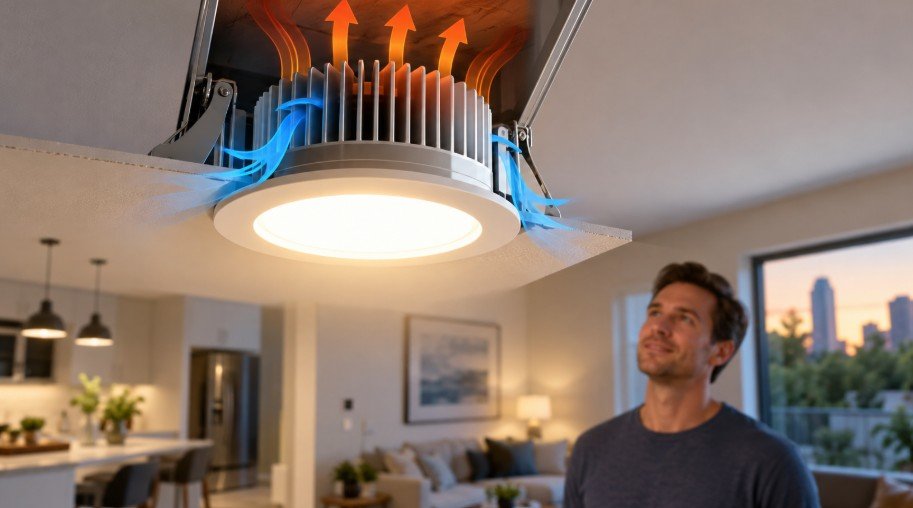
I started paying closer attention to LED fixtures after noticing that some lights stayed warmer than others after running for a few hours. I had assumed an efficient LED should barely produce heat, but that assumption did not hold up. The more I looked at fixture design, the clearer it became that controlling heat is an important part of keeping an LED light bright, stable, and reliable.
I also realized that heat can build around the LED package, circuit board, driver, or housing. That makes LED fixture heat management more than a technical detail when choosing and installing lighting.
Why LED Fixtures Produce Heat
LEDs are efficient, but they are not heat-free. Electrical energy passes through a semiconductor, producing visible light while some energy becomes heat. Unlike an incandescent bulb, an LED does not send most of that heat outward with the light. Heat must travel away from the LED through the fixture’s thermal path.
That path usually begins at the LED package and moves through the circuit board, thermal interface material, heat sink, and housing before reaching the surrounding air. If any part creates too much resistance, heat can remain concentrated near the LED.
How Heat Affects Lighting Performance
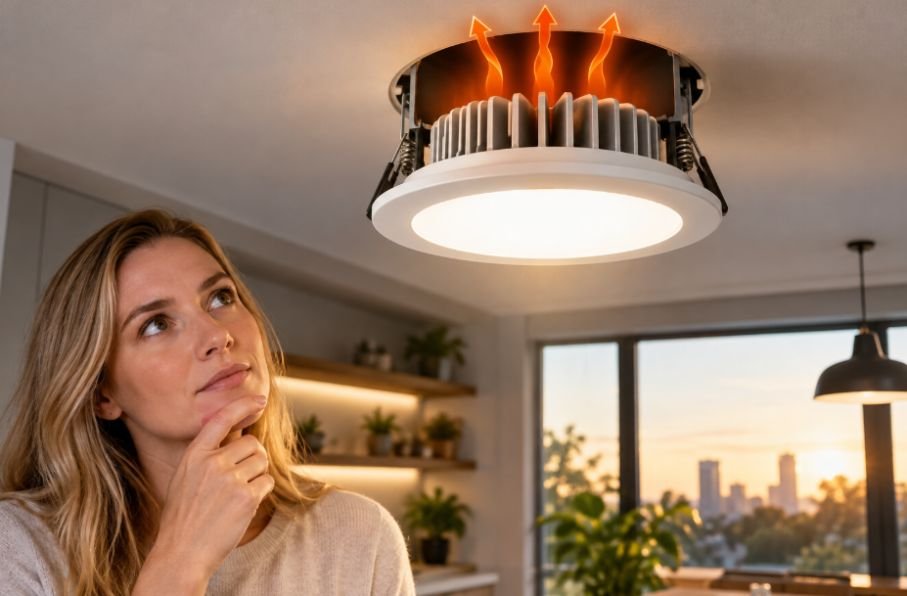
Temperature has a direct relationship with LED performance. As the LED junction becomes hotter, light output can decline, while long-term degradation can accelerate. LEDs usually do not fail like incandescent bulbs with an abrupt burnout. Instead, they gradually lose brightness through lumen depreciation.
Color performance can suffer too. LEDs that use phosphor materials to create white light can experience changes in color characteristics as components age under excessive heat. For homeowners, that may appear as a fixture that no longer looks quite like the warm or cool white tone originally selected.
Heat can also affect the driver. These electronic components have their own temperature limits, and repeated exposure to high temperatures can contribute to flickering, shortened component life, or premature fixture failure.
The Main Ways LED Fixtures Manage Heat
Heat sinks create a path for dissipation
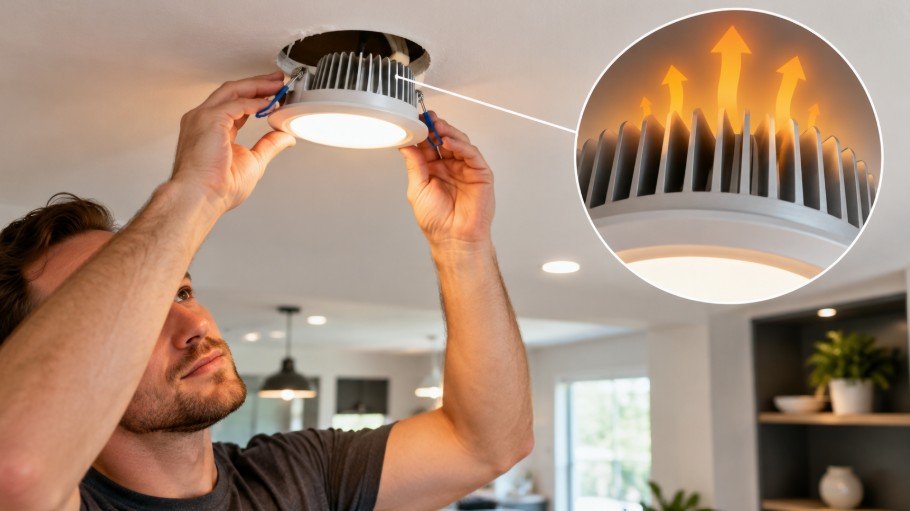
A heat sink provides a larger conductive surface for moving heat away from the LED. Aluminum is common because it transfers heat effectively and can be shaped with fins that increase contact with surrounding air.
The process is simple: heat moves from the LED into the heat sink, then leaves through convection and radiation. A larger heat sink can help, but size alone does not guarantee good performance. The entire thermal path matters.
Why Recessed and Enclosed Fixtures Need Extra Attention
Installation conditions can change how effectively a fixture releases heat. A recessed light surrounded by insulation has less opportunity to exchange heat with open air than a fixture mounted beneath an open ceiling. That is why the fixture’s rating and installation instructions matter.
Insulation-contact, or IC-rated, fixtures are designed for specific insulation conditions, while fixtures without that rating may require clearance. Ignoring those requirements can restrict heat dissipation and create unnecessary thermal stress.
Enclosed fixtures deserve similar attention. A fixture designed for open air may behave differently when surrounded by materials that limit airflow, so its approved installation environment should always be checked.
Practical Ways to Improve LED Fixture Heat Management
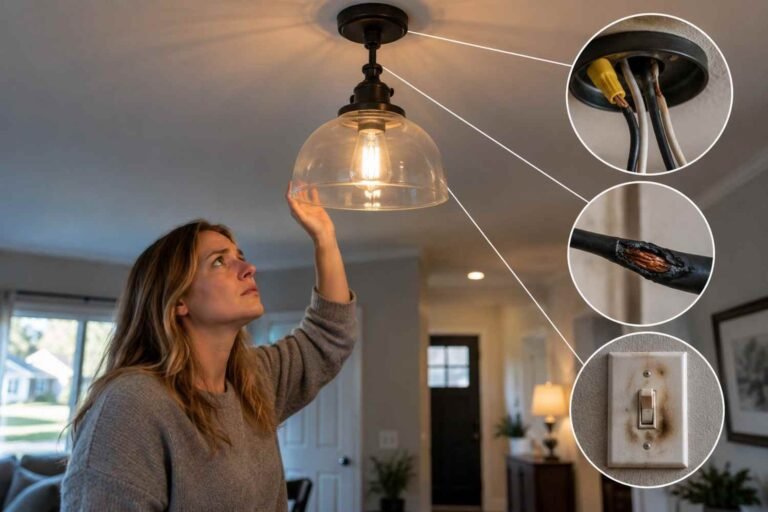
When converting regular light switches to smart switches, the switch and fixture should still be treated as parts of the electrical and lighting system, rather than assuming smart controls change the fixture’s thermal needs. These choices are especially useful in kitchens, attics, garages, outdoor areas, and other locations where ambient temperatures can vary even across changing seasons.
A few decisions can reduce avoidable thermal stress:
- Choose fixtures with ratings suited to the intended location.
- Keep heat sinks, vents, and designed cooling surfaces free from dust and obstruction.
- Follow manufacturer requirements for insulation clearance, enclosure use, and installation position.
- Do not assume a brighter or higher-wattage replacement will have the same thermal requirements as the original.
The Driver Matters Too
The LED chip is only one part of the lighting system. The driver converts incoming electrical power into the form the LED needs, and that electronics package generates its own heat.
Separating the driver from the hottest portion of the LED array can reduce thermal interaction between components. In some fixture designs, the driver is positioned where it can release heat more effectively. That is one reason fixture construction deserves attention beyond appearance.
For connected lighting, thermal considerations can become even more relevant because controls and wireless components may share limited space inside the housing.
Outdoor Conditions Can Change the Thermal Picture
Outdoor lighting faces a different combination of heat, moisture, dirt, and weather exposure. A fixture may need to manage heat while also protecting its electrical components from the environment.
That makes material selection and enclosure design important. Good outdoor lighting corrosion prevention can help preserve housings, connections, and thermal surfaces that might otherwise deteriorate. Corrosion can eventually interfere with connections or surfaces for moving heat away from components.
The goal is not to make an outdoor fixture weather-resistant. It is to maintain the operating environment so its thermal and electrical systems continue working.
Frequently Asked Questions
1. Do LED fixtures get hot?
Yes. LEDs produce heat internally, even though they are more efficient than incandescent lighting. A properly designed fixture moves that heat away from sensitive components.
2. Can excessive heat reduce LED brightness?
Yes. Higher operating temperatures can accelerate lumen depreciation, meaning the fixture gradually produces less light as it ages.
3. Are recessed LEDs more difficult to cool?
They can be. Recessed installation can limit airflow and place fixtures near insulation, so the correct fixture rating and installation method are important.
4. Does the LED driver need thermal protection?
Yes. Drivers contain temperature-sensitive electronic components. Good fixture design manages heat around both the LED and its driver.
Cooler Design, Better Light Over Time
Good LED fixture heat management is ultimately about preserving the performance people expect from efficient lighting. The right heat sink, thermal pathway, driver placement, fixture rating, and installation conditions work together to control operating temperatures. These details may seem invisible when a fixture is new, but they become noticeable when a poorly managed light begins to dim, shift color, flicker, or fail earlier than expected.
The best lighting is often the lighting that keeps doing its job quietly. Managing heat well helps make that possible, protecting both light quality and fixture value over time.







One thought on “How LED Fixture Heat Management Improves Lighting Performance”