
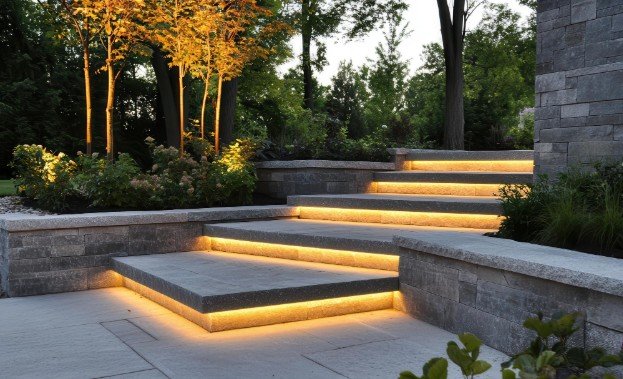
I have found that an outdoor staircase can be brightly illuminated and still remain hazardous. A powerful fixture may produce glare, conceal tread edges, or cast shadows that make changes in elevation difficult to judge.
Understanding how to light outdoor steps safely means illuminating the walking surface evenly while keeping the light source away from people’s direct line of sight. The right system should reveal each tread, riser, landing, and handrail without making the surrounding area unnecessarily bright.
Why Safe Outdoor Step Lighting Matters
Outdoor steps become difficult to navigate when their edges blend together after dark. Rain, ice, fallen leaves, uneven stone, faded finishes, and changing tread depths can further increase the risk of slipping or missing a step.
People with reduced vision may find low-contrast surfaces especially challenging. Effective lighting creates visible separation between consecutive steps and makes the beginning and end of the staircase immediately recognizable. It also helps users locate handrails and notice turns before reaching them.
Safety lighting should produce balanced visibility rather than dramatic brightness. Decorative effects can be added afterward, but the walking surface must remain the priority.
Choose Downward-Directed Fixtures
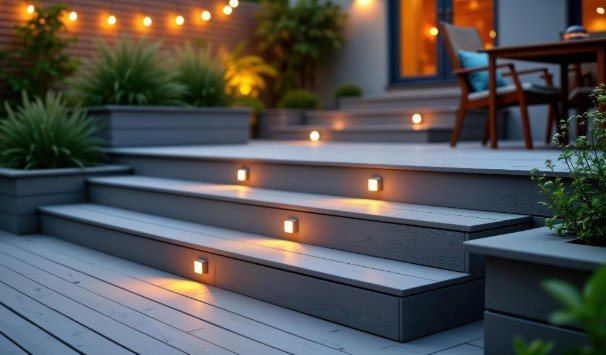
Recessed riser lights are among the most effective options because they illuminate the tread directly below without occupying the walking surface. Horizontal fixtures can spread light across wide steps, while smaller lights suit compact staircases.
Under-tread LED strips create a continuous glow along the front of each step. The strip should be concealed beneath the tread lip or installed inside a suitable channel. Hiding the individual LEDs reduces glare and helps the light appear smooth.
Hardscape lights work well when stairs run beside a retaining wall. Their slim fixtures can distribute light across the treads without cluttering the structure. Downlights attached to railing posts are another useful option, provided they do not interfere with the gripping area.
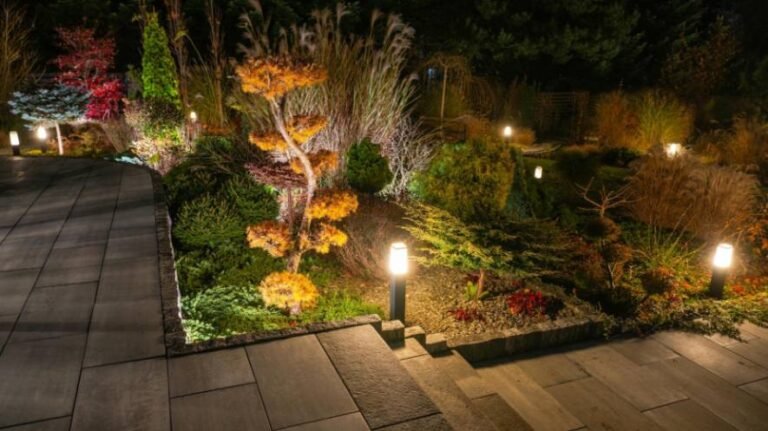
Where built-in installation is impractical, shielded path lights can illuminate steps from the side. Their beams should cross the walking surface instead of pointing upward or toward approaching users.
Make Every Tread Clearly Visible
A light does not always need to be installed on every step. One properly positioned fixture may cover two or three treads on a short, straight staircase. The deciding factor is whether every edge remains visible, not the number of fixtures installed.
Long, steep, curved, wide, or irregular staircases normally need closer spacing. Lights may be staggered along alternating sides to spread illumination evenly. Wide stairs may require fixtures on both sides so the middle does not disappear into shadow.
The top and bottom landings deserve particular attention. These transition points are where users change direction or move between level ground and stairs. Corners, doorways, and isolated single steps should also receive dedicated illumination because an unexpected change in height is easy to overlook.
Use Enough Light Without Creating Glare
Lumens alone cannot determine whether a staircase is safely illuminated. Fixture height, beam angle, surface color, spacing, and surrounding darkness all affect the result. A low-output light positioned close to a pale tread may perform better than a much brighter fixture aimed from a distance.
Avoid exposed bulbs, upward-facing spotlights, and fixtures positioned near eye level. A bright source can temporarily reduce night vision and make the next step harder to see. Shielded housings, diffused lenses, and downward-facing beams keep the light where it is needed.
Dark stone, broad steps, and heavily landscaped areas may require additional fixtures. Pale concrete and reflective surfaces generally need less output. The goal is consistent coverage without harsh pools of light or deep shadows between fixtures.
Select a Comfortable Color Temperature
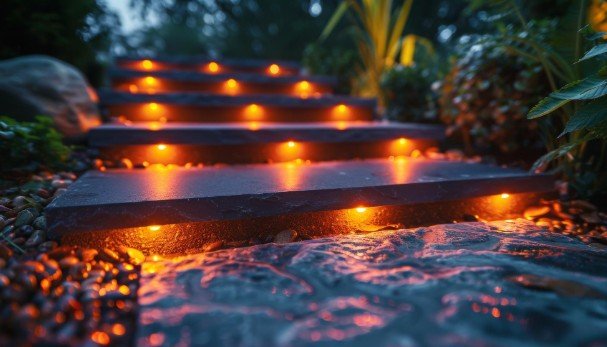
Warm-white LEDs between 2700K and 3000K are suitable for most outdoor staircases. They provide comfortable visibility, complement materials such as wood and stone, and appear less harsh than blue-rich light.
Color consistency also improves visual comfort. Mixing warm step lights with cool-white wall fixtures can create distracting changes in appearance. Using similar color temperatures along the stairs and connecting pathway creates a smoother transition.
Choose a Reliable Power Source
Low-voltage wired lighting is commonly chosen for permanent outdoor stairs because it provides reliable and consistent output. Many outdoor lighting ideas for decks use the same system to illuminate steps, railings, and walking surfaces.
The transformer must have enough capacity for the combined fixture load, and the cable size should account for distance and voltage drop. All connections must follow the manufacturer’s instructions and applicable local requirements.
Solar lights are easier to install, but their output depends on direct sunlight, battery condition, season, and weather. They may be useful as supplemental markers, although heavily used stairs should not rely on inconsistent illumination. Line-voltage systems require additional electrical precautions. A qualified electrician should complete work involving mains power when local regulations or installation complexity require professional service.
Use Weather-Appropriate Components
Fixtures exposed to rain or melting snow should be rated for wet locations. Damp-location products are intended for sheltered areas and may not withstand direct exposure. An IP rating can indicate resistance to water and dust, but the complete product must still be suitable for its installation environment.
Outdoor electrical systems should use appropriate ground-fault protection and weatherproof enclosures. Cables must never cross a tread, hang from a handrail, or create a new tripping hazard.
Photocells can activate the lights at dusk, while timers limit unnecessary operation. Motion sensors are useful when they detect someone before the first step and keep the system illuminated long enough to complete the journey.
Frequently Asked Questions
1. How to light outdoor steps safely without lighting every riser?
Use shielded wall, railing, hardscape, or path lights with overlapping downward beams. Test the staircase from both directions to confirm that every tread and landing remains visible.
2. What color light works best for exterior steps?
Warm-white light between 2700K and 3000K generally provides comfortable visibility and complements most landscaping and building materials.
3. Are solar lights dependable for stair safety?
They can provide supplemental illumination where they receive sufficient sunlight. Their brightness and operating time may decline during winter, prolonged cloud cover, or as batteries age.
4. Should step lights remain on throughout the night?
Not necessarily. Photocells, timers, or well-positioned motion sensors can provide light when required, provided the staircase illuminates before anyone begins using it.
A Safer Final Step
I believe the best stair lighting is noticeable through its results rather than its brightness. When I can identify every tread, reach the handrail easily, and travel in either direction without seeing an exposed bulb, the design is working properly.
Downward beams, even coverage, warm color, reliable power, weather-rated equipment, and regular maintenance can transform a dark staircase into a comfortable and secure route.




2 thoughts on “How to Light Outdoor Steps Safely: Avoid These Mistakes”