
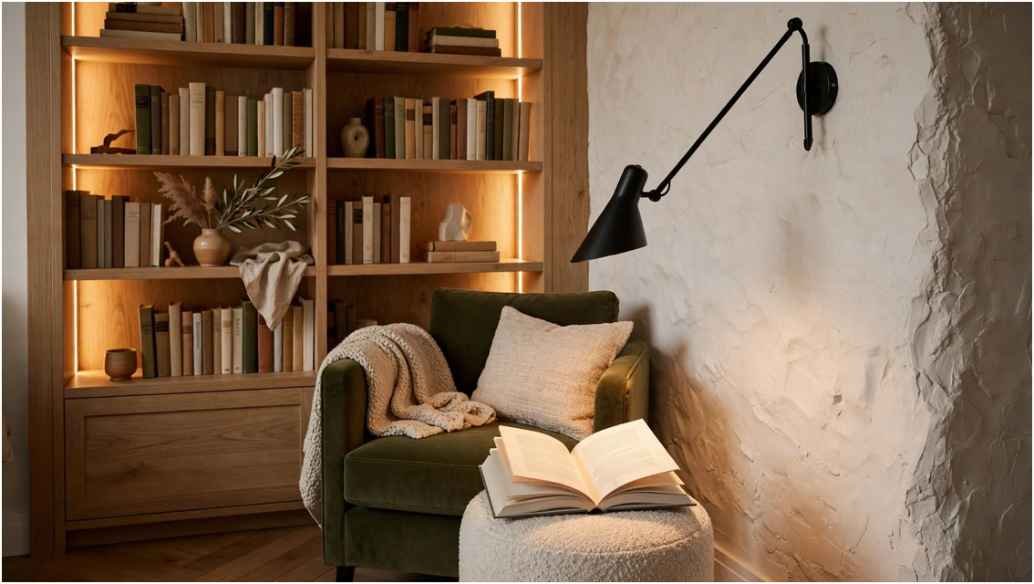
I squeezed a reading chair into a 6-by-6-foot corner of my apartment last year, and the lighting nearly ruined it. One overhead bulb left half my book in shadow while the other half glared back at me. The best indoor reading corner lighting setup for small spaces isn’t about buying a bigger lamp. It’s about layering light correctly in a footprint that can’t spare an inch.
Why One Lamp Never Works in a Tight Corner
I started with a single floor lamp angled over my shoulder. Within a week, I had a headache after every 30-minute reading session. The problem wasn’t brightness. It was contrast. My book sat under 600 lumens while the rest of the room stayed near-dark, forcing my eyes to constantly readjust.
The American Academy of Ophthalmology points out that when a light source is much brighter than its surroundings, your eyes have to work harder, which drives fatigue faster than brightness alone. That single fix, adding a second, softer light source, cut my reading headaches almost immediately.
The Two-Layer Formula That Fits Small Spaces

Every reading corner needs task light and ambient light working together. Skip either one and you’re back to eye strain or a flat, clinical glow.
| Layer | Job | Fixture that fits small spaces |
| Task | Focused light directly on the page | Swing-arm sconce, slim arc floor lamp, clamp-on light |
| Ambient | Soft background glow that balances contrast | Dimmable smart bulb, LED strip, low-wattage table lamp |
Task light alone creates the shadow-glare problem I had. Ambient light alone leaves your page underlit. Both together, at roughly a 3:1 brightness ratio between task and ambient, is what actually works.
Three Fixtures I Tested in a 6×6 Corner
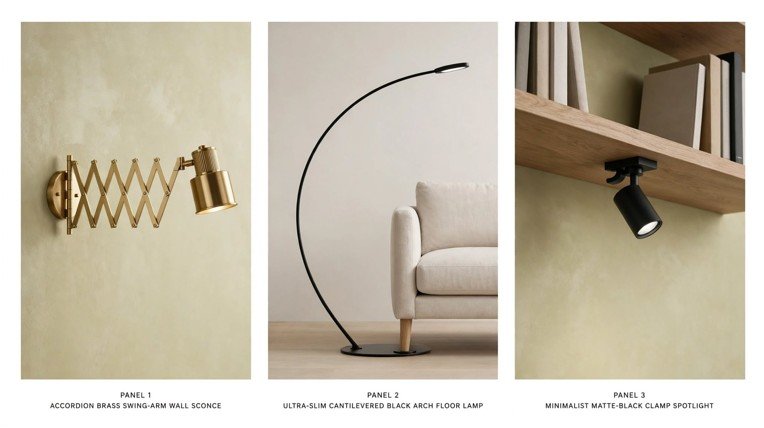
I rotated through three setups over three months before landing on a favorite.
Swing-Arm Wall Sconce
Mounted beside my chair at shoulder height, this took zero floor space. I could pull it directly over the page and fold it flat against the wall when done. A plug-in version meant no electrician visit.
Slim Arc Floor Lamp
The base tucked behind my chair leg, and the arm swept the light source over my shoulder. It looked elegant but needed 18 inches of clearance behind the seat, tight in a true micro-space.
Clamp-On Shelf Light
I attached this to a floating shelf above the chair, combining storage and lighting in one vertical footprint. It became my daily setup because it freed the floor entirely and let me store my current stack of books within reach.
The sconce and the clamp-on light tied for best small-space performance. The arc lamp only wins if you have a few extra inches to spare.
Bulb Specs That Matter More Than the Fixture
I swapped bulbs four times before settling on the right combination, and the difference mattered more than any fixture I bought.
| Spec | Target range | Why |
| Color temperature | 3000K–3500K | Warm enough to relax, cool enough to stay alert |
| Brightness | 450–800 lumens | Matches a 40–60W incandescent without overpowering a small room |
| CRI | 90+ | Sharpens text-to-page contrast |
ENERGY STAR’s bulb guidance confirms that certified LEDs at this lumen range replace standard 40–60W bulbs while using a fraction of the energy, which matters if your reading light stays on for hours each evening.
Lighting designers echo the same layering logic for tight footprints: casting light upward or at an angle in a small corner reads as more spacious than a single flat overhead beam, according to designer-sourced small-space lighting research. If you’re deciding how a bulb should shift between rooms, our guide on warm white vs cool white indoor lighting room by room breaks down exactly where each temperature belongs.
I read late most nights, and swapping to a 3000K bulb after 8 p.m. made falling asleep noticeably easier. Harvard Health’s research on light exposure explains why: even low levels of light exposure can interfere with your body’s circadian rhythm and melatonin release, which is reason enough to avoid cool white bulbs anywhere near a bedtime reading chair.
Placement Mistakes That Create Shadows and Glare
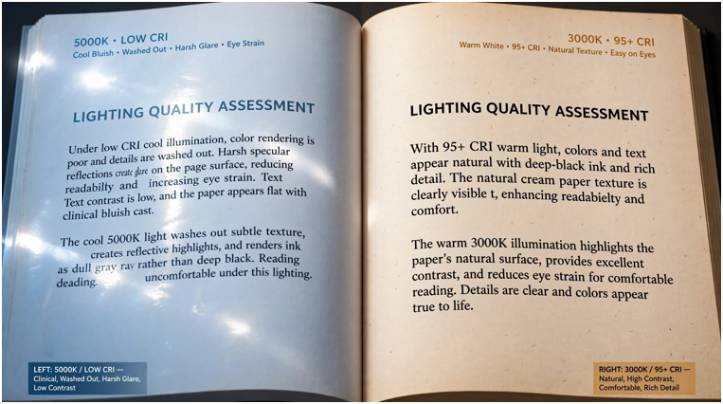
My first setup failed because I placed the sconce directly above my head instead of slightly behind my shoulder. Overhead placement casts a shadow from your own head onto the page. Move the fixture 12 to 18 inches behind and above your reading shoulder, angled down at roughly 30 degrees, and the shadow disappears.
This is the same principle that applies to any close-work station in your home. If your desk setup has the same problem, our piece on how to eliminate harsh shadows in home office lighting walks through the fix in more detail. For small reading nooks specifically, corner placement near a light-colored wall also helps, since the wall reflects and softens the beam instead of creating a single harsh point.
Stop Reading in the Dark Like It’s a Personality Trait
A cramped corner isn’t an excuse for bad light. Pick one task fixture that clears your floor, pair it with a warm ambient bulb, and angle it behind your shoulder instead of overhead. That’s the whole setup. Test it for one week before buying anything else, your eyes will tell you fast if it’s working.
FAQs
1. What’s the best light color for a small reading nook?
3000K to 3500K warm white balances coziness with enough clarity to read comfortably.
2. Can I use a floor lamp in a tiny corner?
Yes, if you have at least 18 inches of clearance behind the chair; otherwise choose a wall sconce or clamp-on light instead.
3. How many lumens do I need for reading?
Aim for 450 to 800 lumens focused directly on the page.
4. Does light color affect sleep if I read before bed?
Yes, cooler or bright white light suppresses melatonin more than warm light, so switch to warm white in the evening.

One thought on “Best Indoor Reading Corner Lighting Setup for Small Spaces”