Halloween pathway lighting has one job that matters more than atmosphere: helping children see where they are stepping. Safe Kids Worldwide notes that children are more than twice as likely to be hit by a car and killed on Halloween than on an average day, which makes visibility a practical part of decorating.
The best spooky pathway lighting for trick or treaters does two things at once. It creates a haunted approach to the front door while revealing steps, curbs, uneven paving, cords, decorations, and changes in direction.
The goal is not maximum brightness. It is controlled visibility with enough contrast to feel spooky without hiding hazards.
Build the Haunt Around the Walking Route
Start from the sidewalk, not the porch. Trick-or-treaters experience the scene in sequence: curb, path entrance, walkway, steps, porch, then the door.
Walk that route after dark and look for places where the ground disappears into shadow. Pay special attention to raised pavers, cracked concrete, roots, gravel edges, low walls, and sharp turns.
The U.S. Consumer Product Safety Commission’s Halloween safety guidance advises homeowners to remove obstacles from lawns, steps, and porches and to use decorative light strands tested for safety. It also recommends checking for damaged sockets, exposed wires, and loose connections.
A simple rule works well: if a decoration makes the walking route harder to read, move it.
The Best Lighting Effects for a Spooky Walkway
Flickering Flame Stakes Without Real Flames
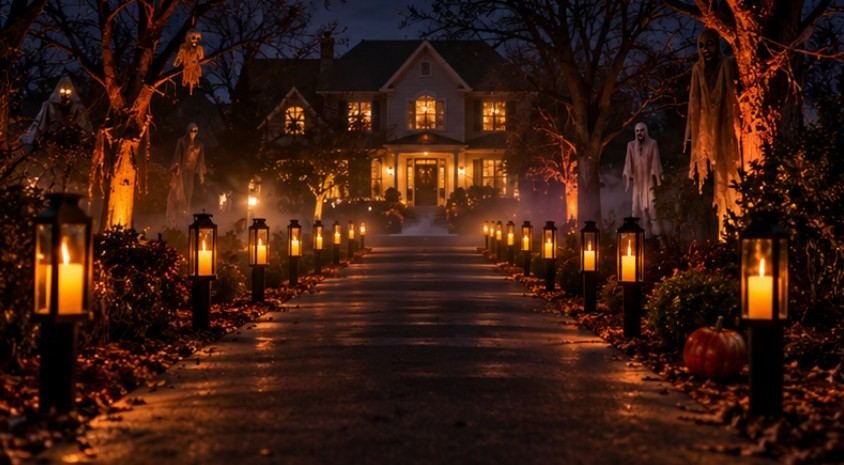
Flickering LED candle stakes create a haunted-lane effect without introducing an open flame. Their moving light feels more dramatic than a steady lamp, especially when placed in staggered spacing.
The National Fire Protection Association’s Halloween safety guidance reports that from 2020–2024, decorations were the first item ignited in an average of 835 home structure fires per year. About one-third were started by candles.
Use battery-operated or low-voltage flame effects around costumes, dry leaves, fabric ghosts, and porch décor.
Skull, Bat, and Graveyard Pathway Markers
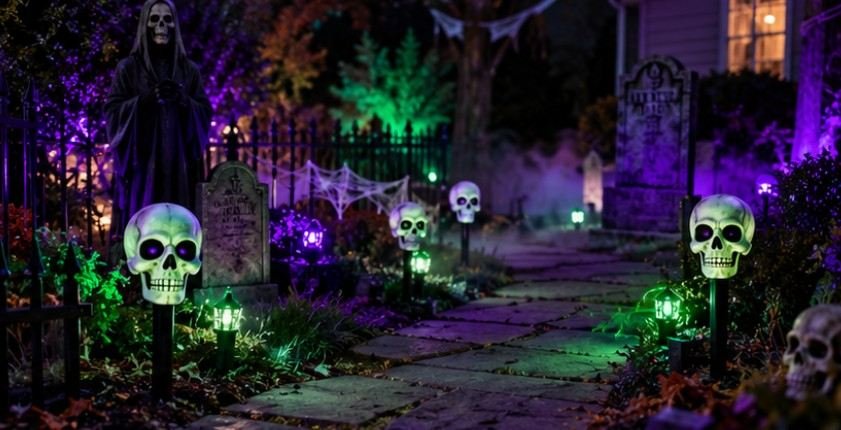
Skull stakes, bat lanterns, tombstone lights, and glowing skeletal hands work best when they do more than decorate. Use them to define the outside edge of the walking route.
Place stakes slightly off the path so excited children are not weaving around them. Red, amber, purple, and green create mood, but add some neutral white light at steps or changes in height so depth remains easy to judge.
String Lights for Curved Paths
String lights can trace a winding walkway, but loose cords should never cross the route.
For landscaped paths, secure low-voltage or battery-powered strings to short stakes, fence edges, shrubs, or railings. Utah State University Extension’s Halloween safety advice recommends low-wattage or LED Halloween lighting and warns that extension cords can create trip hazards.
A Simple Three-Zone Lighting Plan
The easiest way to design spooky pathway lighting for trick or treaters is to divide the approach into three zones.
| Zone | Main Need | Best Lighting Approach |
| Street to entrance | Direction | Lanterns, glowing pumpkins, paired markers |
| Main walkway | Edge visibility | Low LEDs, skull stakes, string lights |
| Steps and porch | Height changes | Brighter neutral LEDs, rail lights, flameless lanterns |
This prevents a common mistake: concentrating all the dramatic lighting at the porch while leaving the first half of the route almost black.
Halloween safety tips for trick or treating recommendations advise children to stay in familiar, well-lit areas and use flashlights or glow sticks. Homeowners can support that by making the path to the door obvious from the street.
DIY Ideas That Look Better Than Their Cost
Pumpkin Pail Pathway Lights
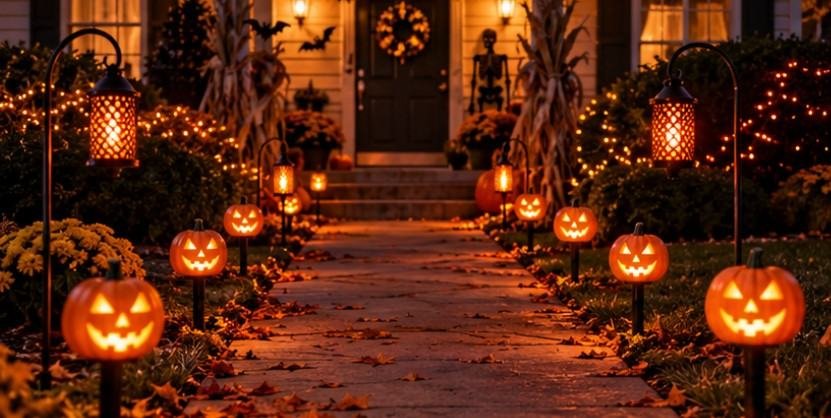
Place battery puck lights or solar stakes beneath inexpensive plastic jack-o’-lantern buckets, layer ambient task and accent then arrange them along the lawn edge.
Avoid perfect symmetry. Slightly uneven spacing makes the route feel more like a haunted trail than an airport runway.
Glow-Stick Ghosts
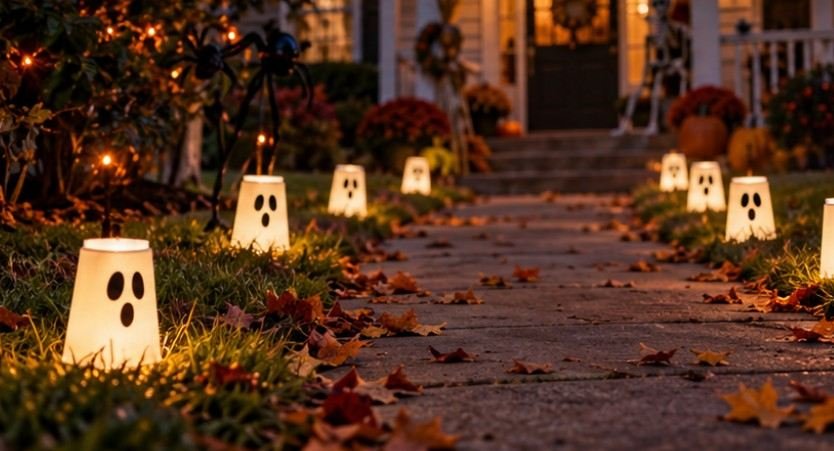
Small translucent cups, mini lanterns, or fabric ghosts can hold glow sticks or battery tea lights. Secure them to stakes and keep them outside the walking surface. This works especially well where outlets are inconvenient.
Backlight Props for Bigger Shadows
Put a small outdoor-rated LED behind a tombstone, skeleton, or crooked branch instead of lighting everything from the front.
The shadow adds drama without cluttering the path. Aim the fixture or use motion sensor outdoor lighting away from approaching faces so glare does not reduce visibility.
The 10-Minute Darkness Test
Test the display after sunset.
Walk from the street to the door at a normal pace. Check whether every curb, step, edge, and surface change is visible. Look for glare from exposed bulbs and confirm that no cord crosses the route.
Then crouch slightly to approximate a child’s lower viewing angle. Large props can block a younger visitor’s view of steps or turns even when an adult can see over them.
Finally, make sure the front door is clearly the destination. A haunted yard can feel mysterious, but the route should never be confusing.
The AAP says well-lit routes, sidewalks, and flashlights for Halloween outings and says families should ideally visit homes with well-lit pathways. The same principle applies to the property itself: visitors should not need to guess where to walk.
What to Buy—and What to Skip
Choose outdoor-rated fixtures, front porch lighting, sturdy stakes, weather-resistant battery compartments, and lighting you can position outside the walking surface. Battery-powered and low-voltage LEDs are especially flexible for temporary displays.
Skip products with cracked housings, damaged cords, unstable bases, or wiring that must run across the path. Avoid real candles near landings, steps, costumes, or combustible decorations.
CPSC recommends flameless, battery-operated lights or glow sticks in jack-o’-lanterns where children may have access and keeping burning candles away from doorsteps where costumes could brush against them.
Frequently Asked Questions
1. How Bright Should Halloween Pathway Lights Be?
Bright enough to reveal the walking surface, steps, and hazards without glare. Use colored lighting for mood and neutral light where height changes must remain visible.
2. Are Solar Lights Good for Halloween Pathways?
Yes, but performance depends on sun exposure. Test them after dark before relying on them for steps, curbs, or the main entrance.
3. Can I Use Real Candles Along a Trick-or-Treat Path?
Battery-operated candles are safer. Open flames can ignite costumes or decorations and should stay away from walkways, steps, and doorways.
4. How Far Apart Should Pathway Lights Be?
Start around 4–6 feet apart, then reduce spacing near turns, steps, uneven surfaces, or darker sections.
Make the Scare Visual, Not Physical
A memorable Halloween walkway does not need to be blinding, expensive, or overloaded with props. The strongest displays use darkness deliberately while keeping the walking line readable.
Treat every light as either a mood-maker or a safety cue. Let skulls, flickering LEDs, glowing pumpkins, and shadows create the fear, while discreet neutral lighting handles the practical work.
That balance makes spooky pathway lighting for trick or treaters successful: guests get the thrill of approaching a haunted house without wondering where the next step is. The best scare should happen when a skeleton moves—not when someone misses the curb.